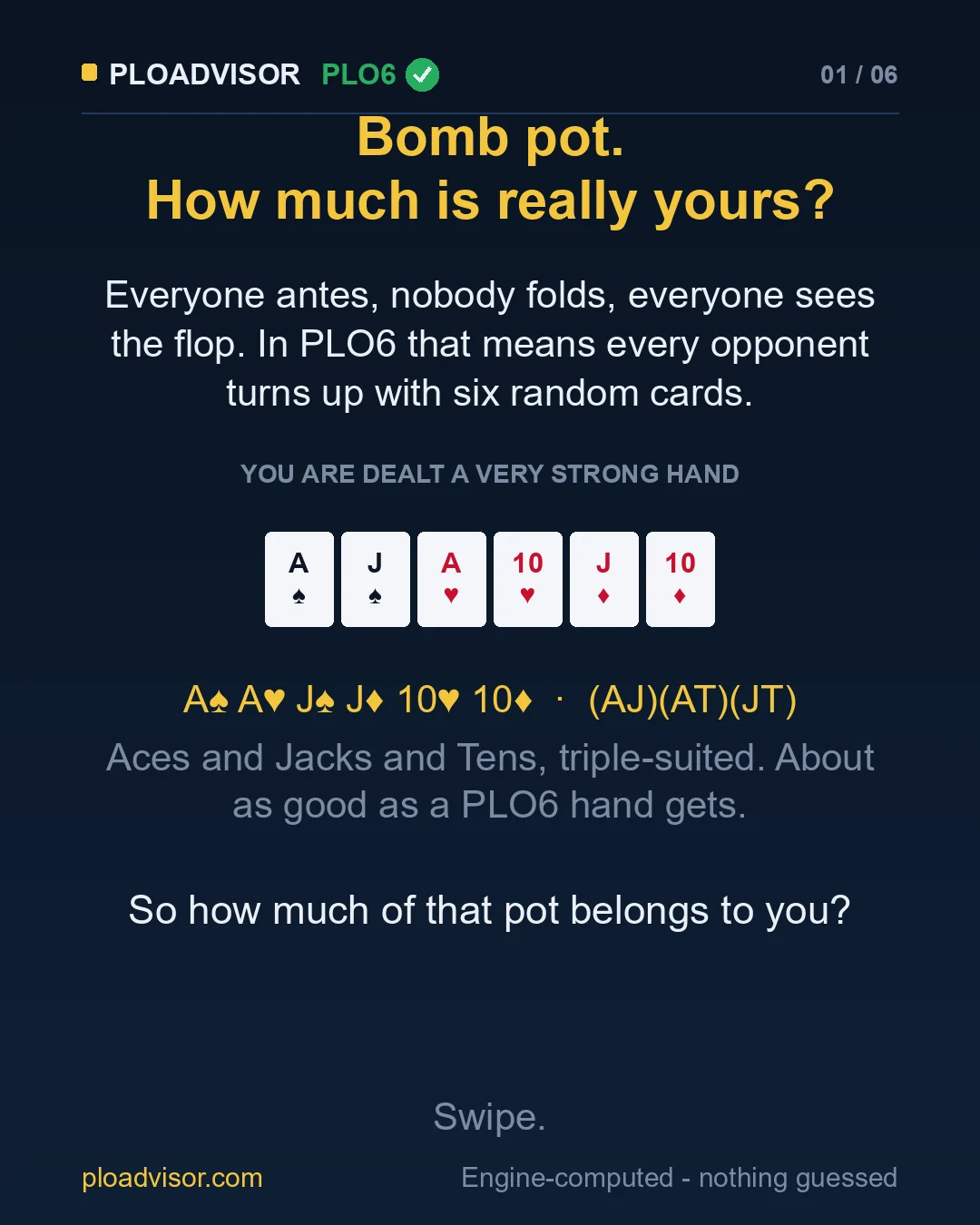
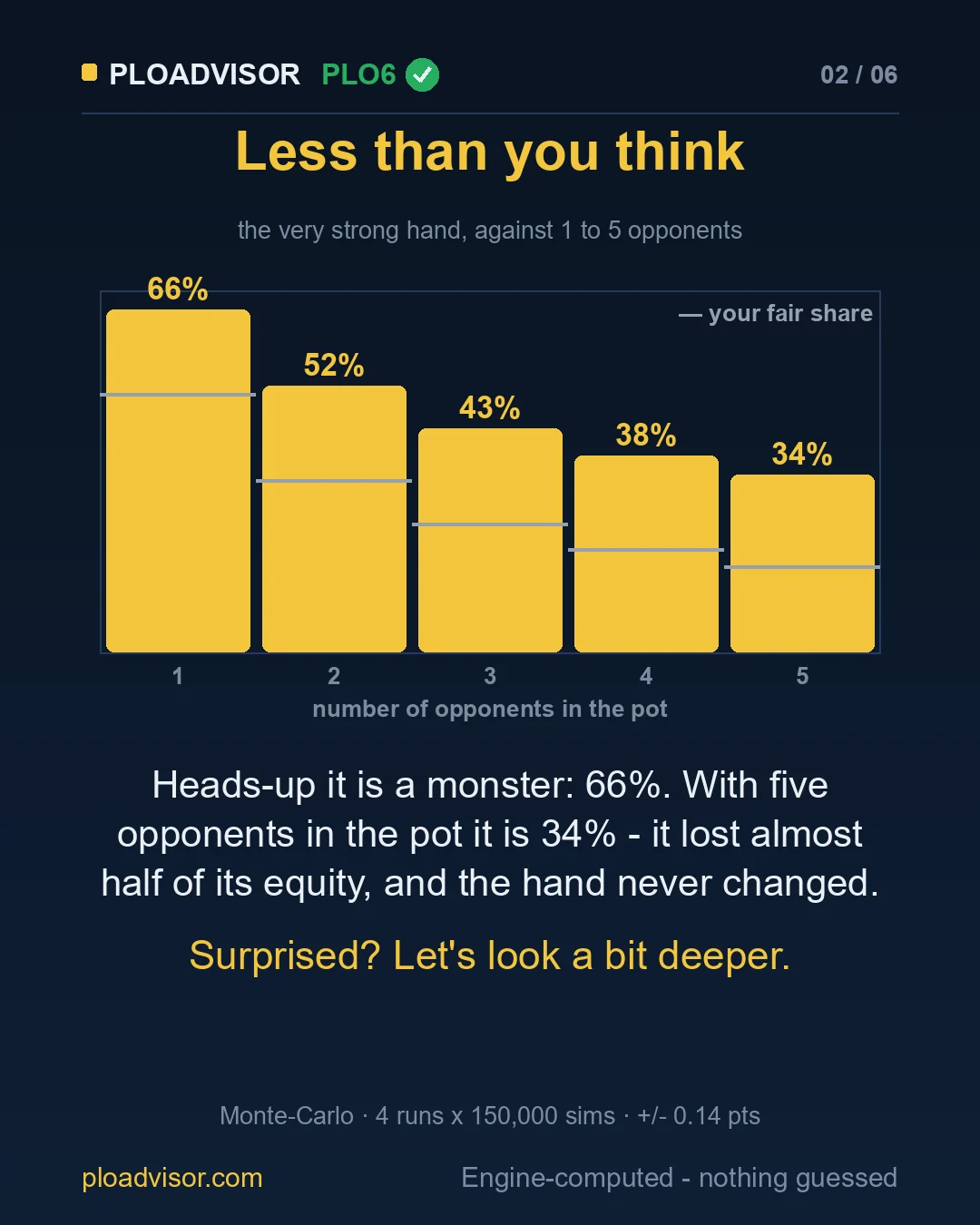
In a bomb pot of PLO6 (six-card Pot-Limit Omaha) a very strong hand — A♠ A♥ J♠ J♦ 10♥ 10♦, triple-suited — has 66.2% equity heads-up and 34.4% against five opponents. It loses almost half of its equity, and the hand never changed. Against five opponents that 34.4% is still about twice the 16.7% the pot owes each player.
Key numbers
- The very strong hand against 1 to 5 random hands: vs 1: 66.2% · vs 2: 51.7% · vs 3: 43.4% · vs 4: 38.1% · vs 5: 34.4%.
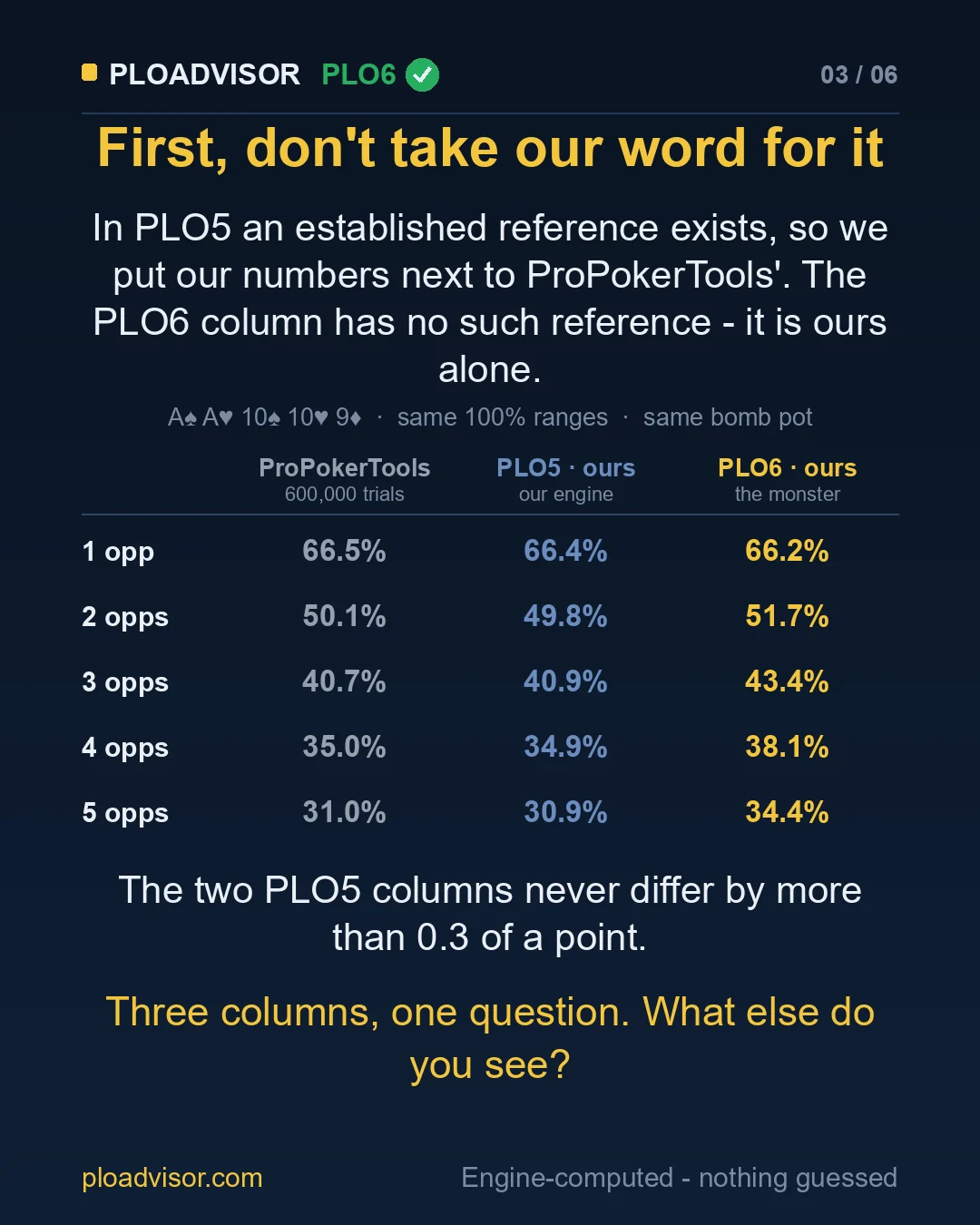
- Our PLO5 numbers sit within 0.3 of a point of ProPokerTools (600,000 trials) on every row.
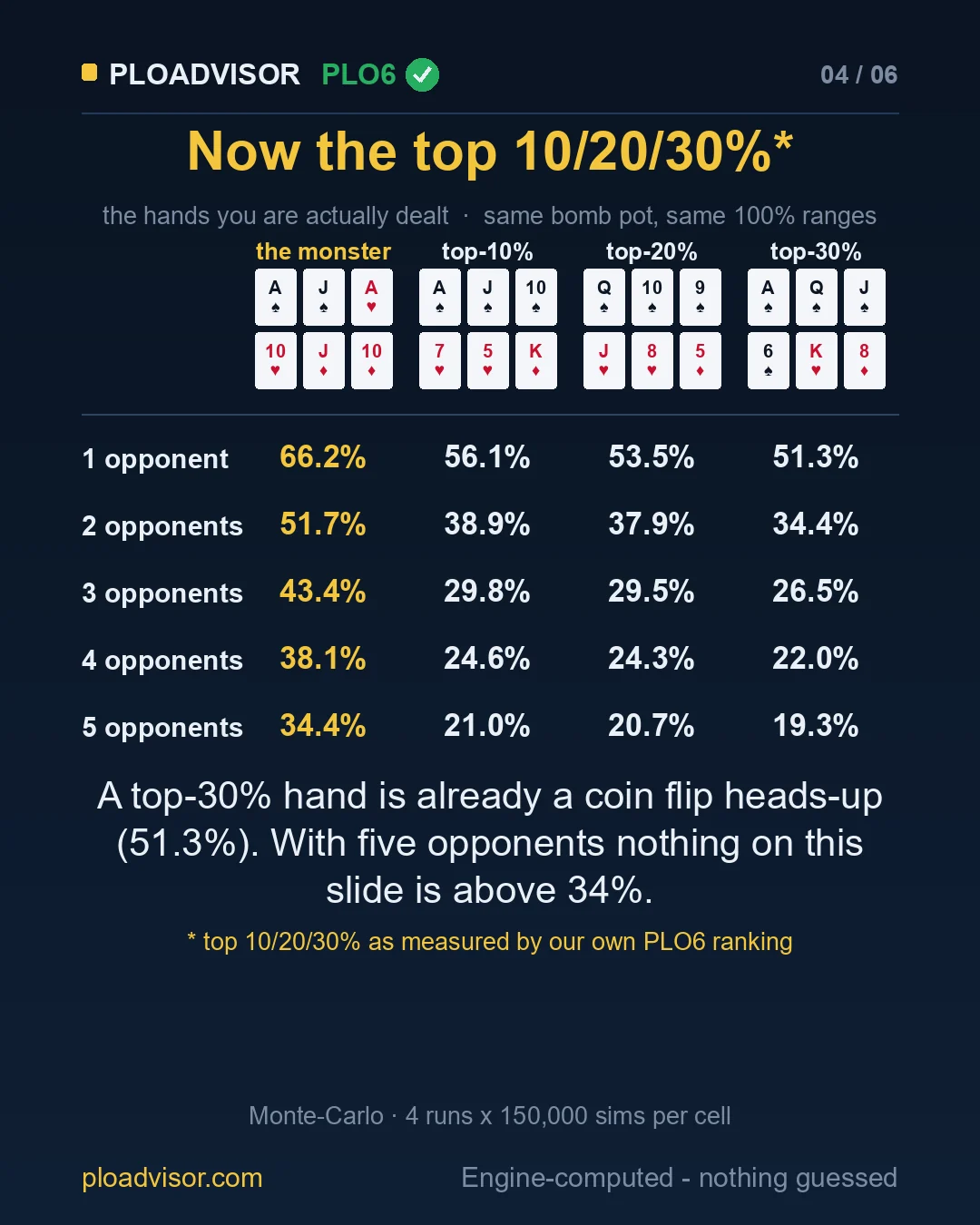
- Hands from our PLO6 ranking against five opponents: top 10% 21.0% · top 20% 20.7% · top 30% 19.3% — within 1.7 points. Heads-up the same hands are 4.7 points apart.
- Fair share with five opponents: 16.7%. The very strong hand takes 34.4%; the top-30% hand 19.3%.
What is a bomb pot, and why every hand is random
Everyone antes, nobody folds, everyone sees the flop. In PLO6 that means every opponent turns up with six random cards — a 100% range, for real. So the equity question here is simple to state: how much of the pot does one hand win, on average, against one to five random PLO6 hands?
How much equity does a very strong hand keep against more opponents?
The hand is A♠ A♥ J♠ J♦ 10♥ 10♦ — (AJ)(AT)(JT) in our notation. Aces and Jacks and Tens, triple-suited. About as good as a PLO6 hand gets.
| Opponents | Fair share | Very strong hand |
|---|---|---|
| 1 opponent | 50.0% | 66.2% |
| 2 opponents | 33.3% | 51.7% |
| 3 opponents | 25.0% | 43.4% |
| 4 opponents | 20.0% | 38.1% |
| 5 opponents | 16.7% | 34.4% |
Heads-up it is a monster: 66.2%. With five opponents in the pot it is 34.4% — it lost almost half of its equity, and the hand never changed. The fair share column is what each player would get if the pot were simply split; we come back to it below.
Checked against ProPokerTools, in PLO5
We know of no established PLO6 reference to check these numbers against. For PLO5 there is one, so we ran the same question there: a very strong PLO5 hand, A♠ A♥ 10♠ 10♥ 9♦, against 1 to 5 random PLO5 hands, in ProPokerTools (600,000 trials) and in our engine. The PLO6 column is ours alone.
| Opponents | ProPokerTools PLO5 | Ours PLO5 | Ours PLO6 |
|---|---|---|---|
| 1 opponent | 66.5% | 66.4% | 66.2% |
| 2 opponents | 50.1% | 49.8% | 51.7% |
| 3 opponents | 40.7% | 40.9% | 43.4% |
| 4 opponents | 35.0% | 34.9% | 38.1% |
| 5 opponents | 31.0% | 30.9% | 34.4% |
The two PLO5 columns never differ by more than 0.3 of a point, and the differences change sign — noise on both sides, not a systematic gap.
Look across, too: heads-up the PLO5 and PLO6 hands are level (66.4% and 66.2%), while with five opponents the PLO6 hand is 3.5 points ahead. They are not the same hand with a card added: A♠ A♥ 10♠ 10♥ 9♦ against A♠ A♥ J♠ J♦ 10♥ 10♦.
The hands you are actually dealt: top 10%, 20% and 30%
The very strong hand is rare. These are hands at the 10%, 20% and 30% marks of our PLO6 playability ranking (6-max), in the same bomb pot, against the same random hands:
| Hand | Cards | Notation |
|---|---|---|
| very strong | A♠ A♥ J♠ J♦ 10♥ 10♦ | (AJ)(AT)(JT) |
| top 10% | A♠ K♦ J♠ 10♠ 7♥ 5♥ | (AJT)(75)K |
| top 20% | Q♠ J♥ 10♠ 9♠ 8♥ 5♦ | (QT9)(J8)5 |
| top 30% | A♠ K♥ Q♠ J♠ 8♦ 6♠ | (AQJ6)K8 |
| Opponents | very strong | top 10% | top 20% | top 30% |
|---|---|---|---|---|
| 1 opponent | 66.2% | 56.1% | 53.5% | 51.3% |
| 2 opponents | 51.7% | 38.9% | 37.9% | 34.4% |
| 3 opponents | 43.4% | 29.8% | 29.5% | 26.5% |
| 4 opponents | 38.1% | 24.6% | 24.3% | 22.0% |
| 5 opponents | 34.4% | 21.0% | 20.7% | 19.3% |
A top-30% hand is already a coin flip heads-up (51.3%). With five opponents nothing in the table is above 34.4%. And the ranking tiers bunch up: against five opponents the top-10% and top-30% hands are 1.7 points apart; heads-up they are 4.7.
What the pot owes you: the fair share
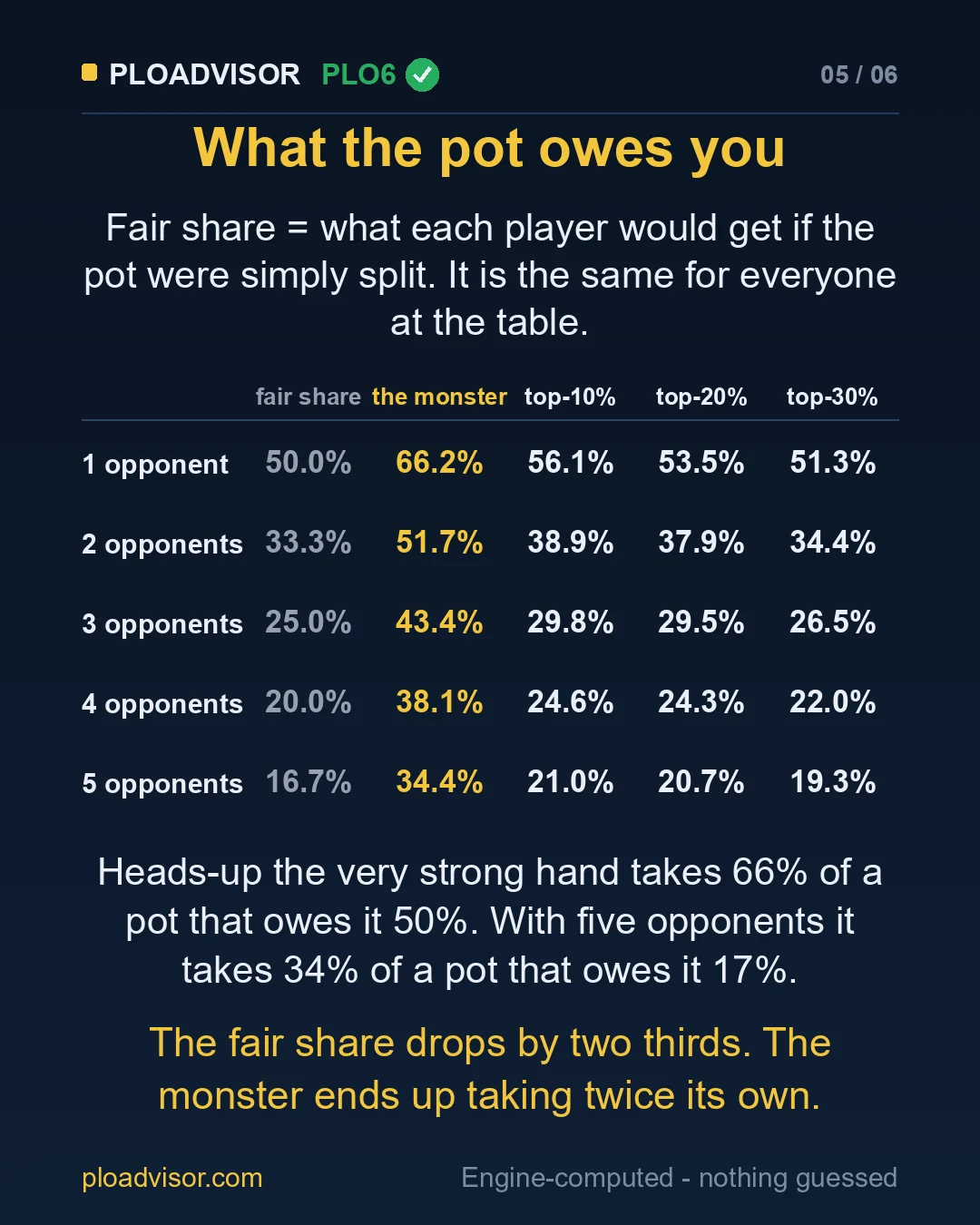
Fair share = what each player would get if the pot were simply split: 100% divided by the number of players in the pot. It is the same for everyone at the table.
| Opponents | Fair share | very strong | top 10% | top 20% | top 30% |
|---|---|---|---|---|---|
| 1 opponent | 50.0% | 66.2% | 56.1% | 53.5% | 51.3% |
| 2 opponents | 33.3% | 51.7% | 38.9% | 37.9% | 34.4% |
| 3 opponents | 25.0% | 43.4% | 29.8% | 29.5% | 26.5% |
| 4 opponents | 20.0% | 38.1% | 24.6% | 24.3% | 22.0% |
| 5 opponents | 16.7% | 34.4% | 21.0% | 20.7% | 19.3% |
Heads-up the very strong hand takes 66% of a pot that owes it 50%. With five opponents it takes 34% of a pot that owes it 17%. The fair share drops by two thirds; the very strong hand ends up taking about twice its own (2.06×). The top-30% hand never gets far from what it is owed: 51% against 50%, then 19% against 17%.
So where is the profit?
Two things are true at once in a 6-max bomb pot: almost every hand you are dealt is worth roughly its fair share — and the rare monster is worth twice it. So it cannot come from just being dealt a good hand: two whole ranking tiers, top 10% against top 30%, are worth 1.7 points with five opponents.

How these numbers were produced
- Simulated: every equity on this page is a Monte Carlo estimate — the average of 4 independent runs of 150,000 deals, with a standard error of at most ±0.14 points per cell. Measured 2026-09-07.
- Opponents: random hands (100% ranges), which is what a bomb pot is. Equity is the share of the pot a hand wins with all the cards dealt out, ties split.
- The tiers: the top-10%, 20% and 30% hands sit at those percentiles of our PLO6 playability ranking (6-max) — how we built it.
- The audit: the ProPokerTools column is a simulation of 600,000 trials per cell, run by our team on the same PLO5 hand against the same random hands.
- Fair share: plain arithmetic, 100% divided by the players in the pot.