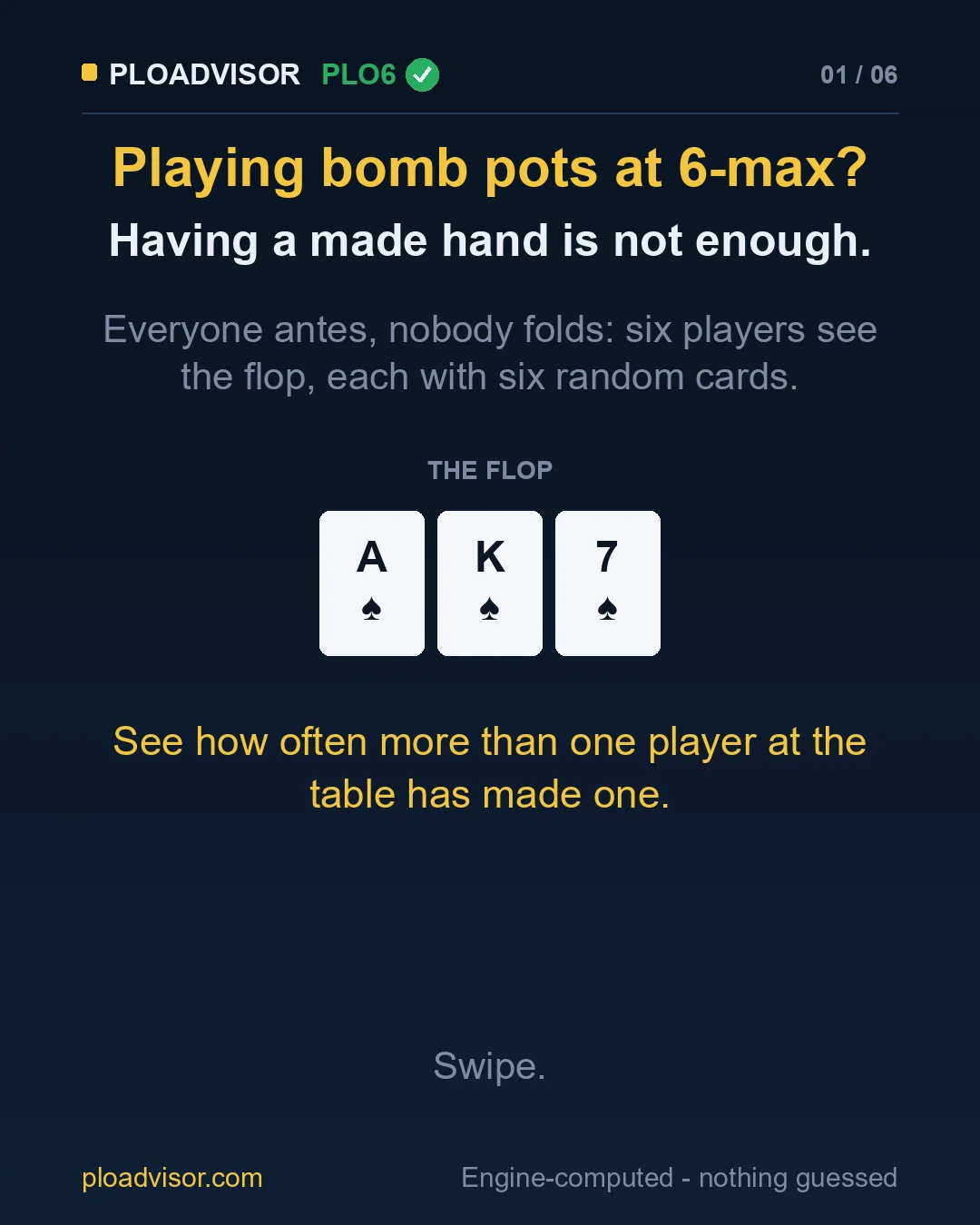
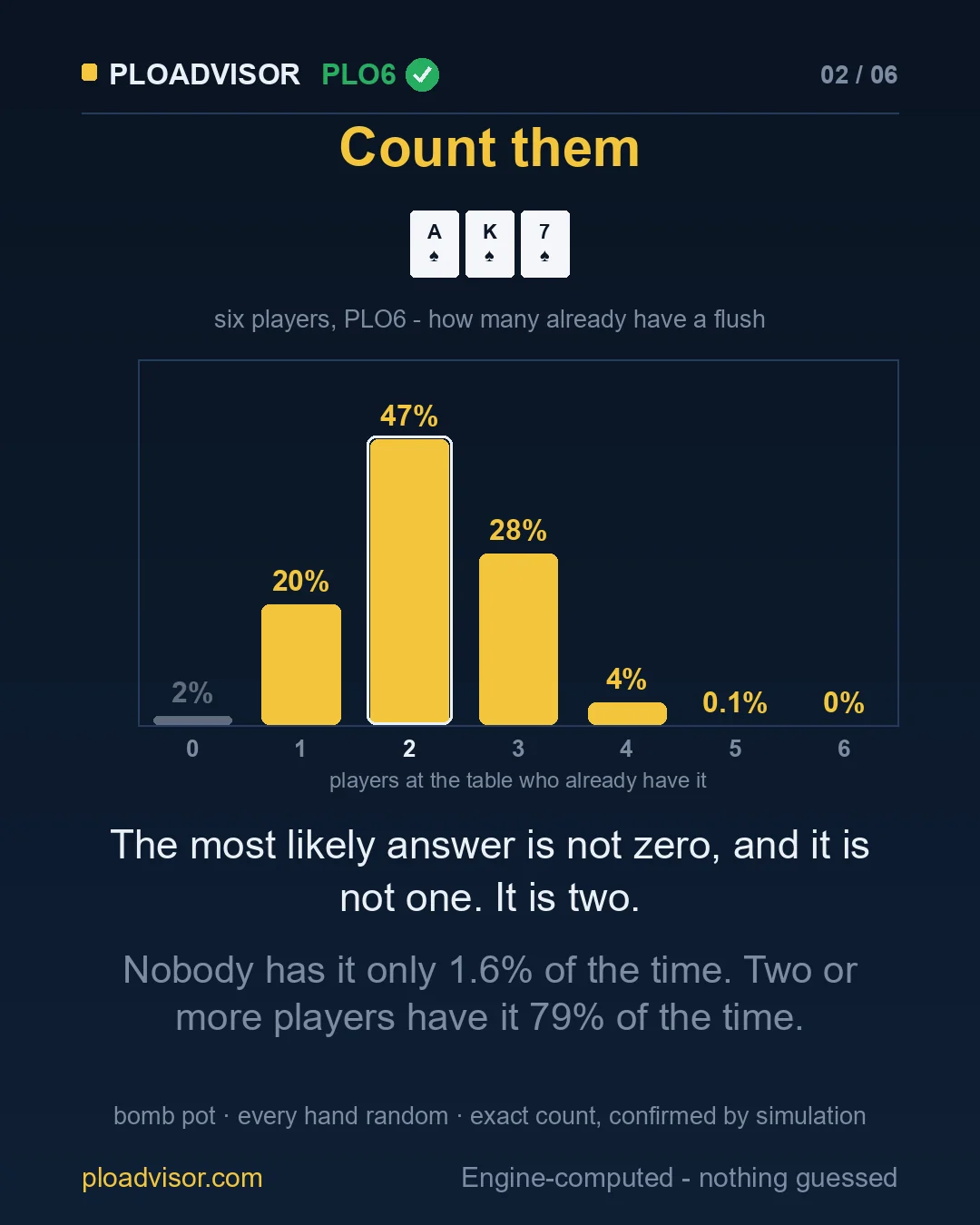
Six players see the flop in a PLO6 (six-card Pot-Limit Omaha) bomb pot and it comes A♠ K♠ 7♠. How many of the six already hold a flush? The most likely answer is not zero, and it is not one: it is two (46.6%). At least one player has a flush 98.4% of the time, and two or more players have one 78.6% of the time.
Key numbers
- Flop A♠ K♠ 7♠, six players, PLO6: nobody has a flush 1.6% · exactly one 19.7% · two 46.6% · three 28.1%.
- Two or more flushes on that flop: heads-up 10.3%, six players 78.6%.
- Six players, same flop, two or more flushes: PLO4 28.4% · PLO5 54.0% · PLO6 78.6%.
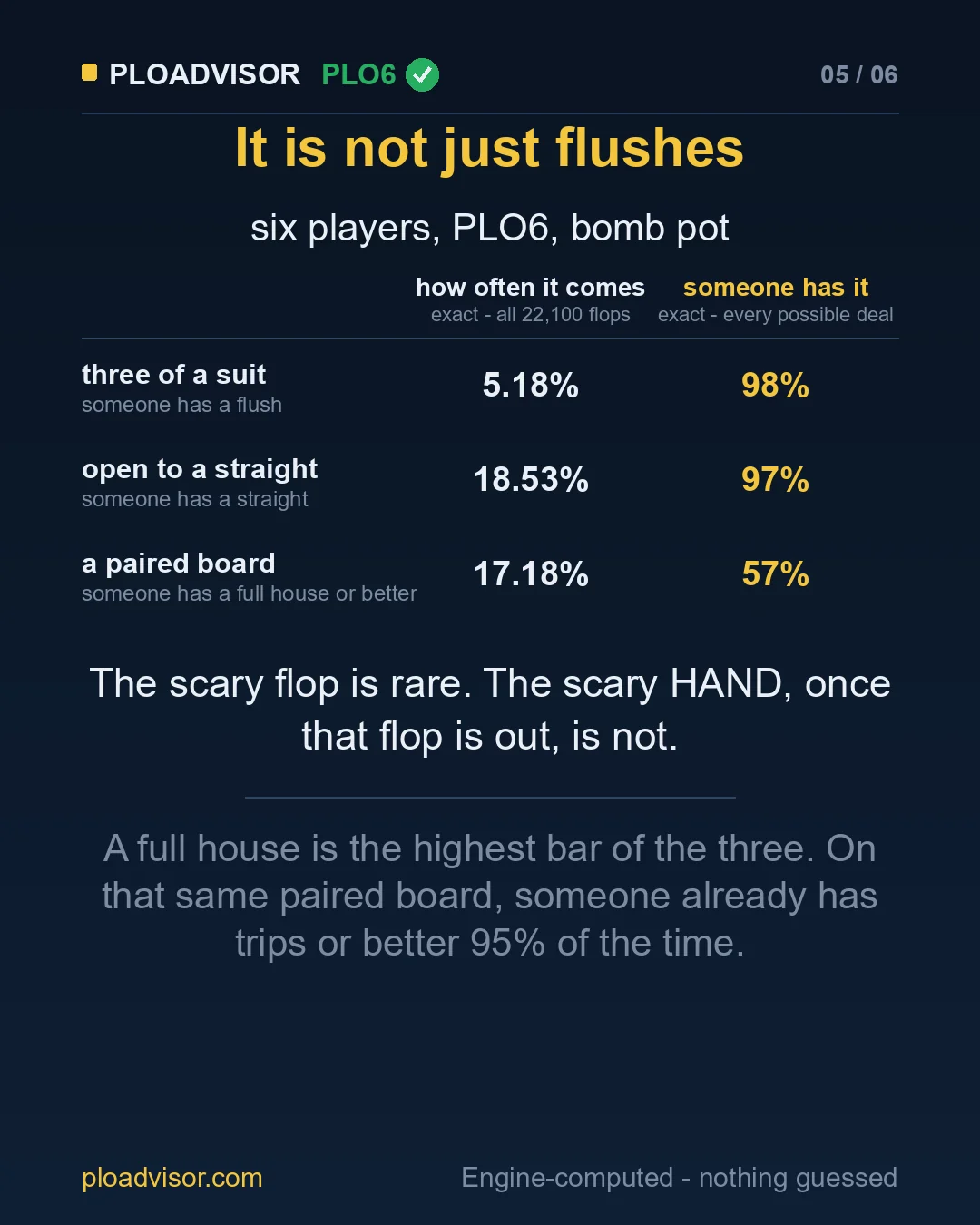
- A monotone flop comes 5.18% of the time and a paired flop 17.18%. Once it is out, the hand it allows is not rare.
- Every number is exact, counted over every possible deal.
How many of the six players hold a flush?
Everyone antes, nobody folds: six players see the flop, each with six random cards. The flop is A♠ K♠ 7♠. Counting every player at the table:
| Players holding a flush | Exact chance |
|---|---|
| 0 | 1.6% |
| 1 | 19.7% |
| 2 | 46.6% |
| 3 | 28.1% |
| 4 | 3.9% |
| 5 | 0.06% |
| 6 | 0% |
Nobody has it only 1.6% of the time. Two or more players have it 78.6% of the time. All six is not possible: six flushes would need twelve spades, and only ten are left in the deck.
It is the table, not the flop
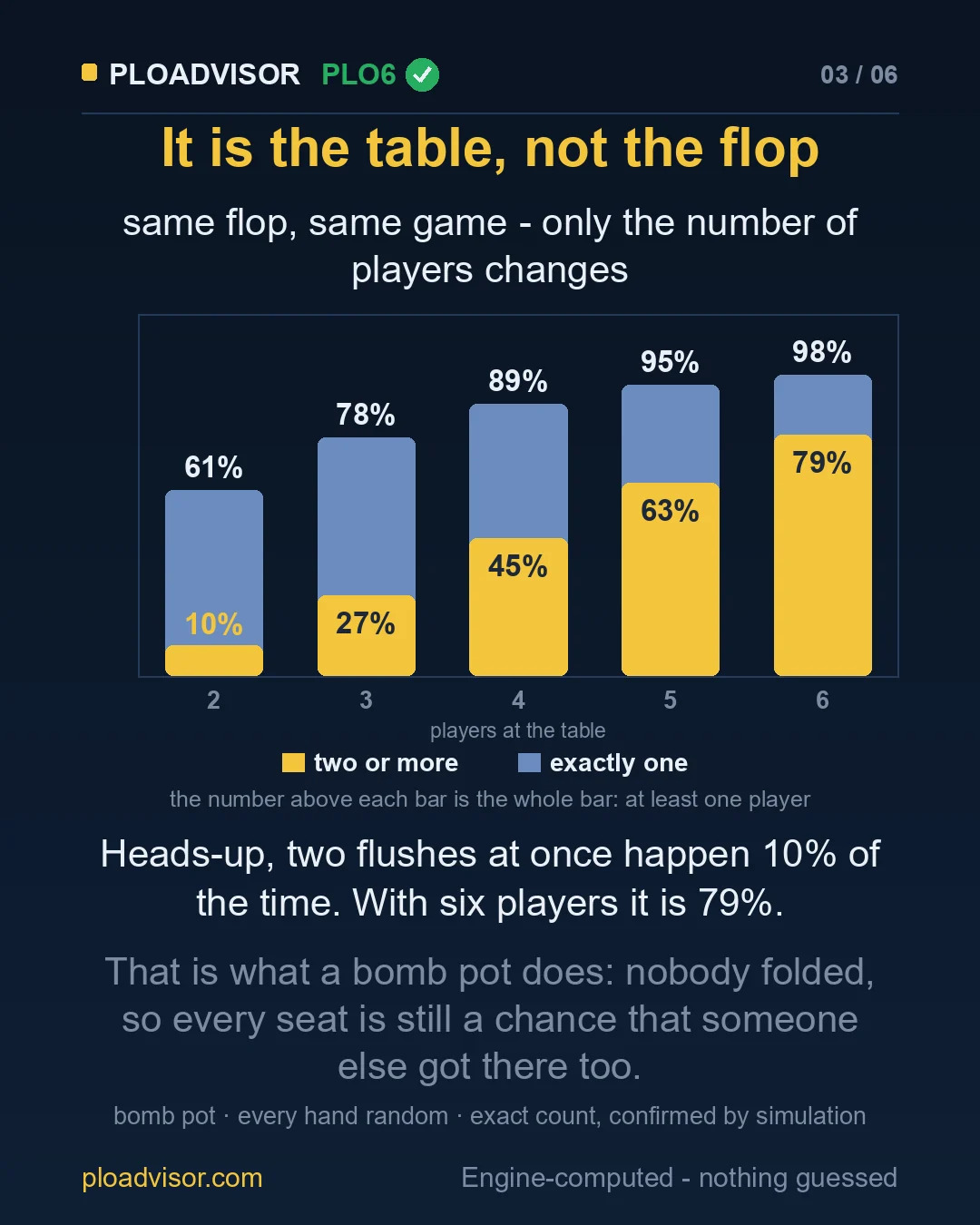
Same flop, same game — only the number of players changes:
| Players at the table | At least one | Exactly one | Two or more |
|---|---|---|---|
| 2 | 60.7% | 50.4% | 10.3% |
| 3 | 77.8% | 51.2% | 26.5% |
| 4 | 88.7% | 43.6% | 45.0% |
| 5 | 95.1% | 32.0% | 63.1% |
| 6 | 98.4% | 19.7% | 78.6% |
Heads-up, two flushes at once happen 10.3% of the time. With six players it is 78.6%. That is what a bomb pot does: nobody folded, so every seat is still a chance that someone else got there too.
PLO4, PLO5 and PLO6 on the same flop
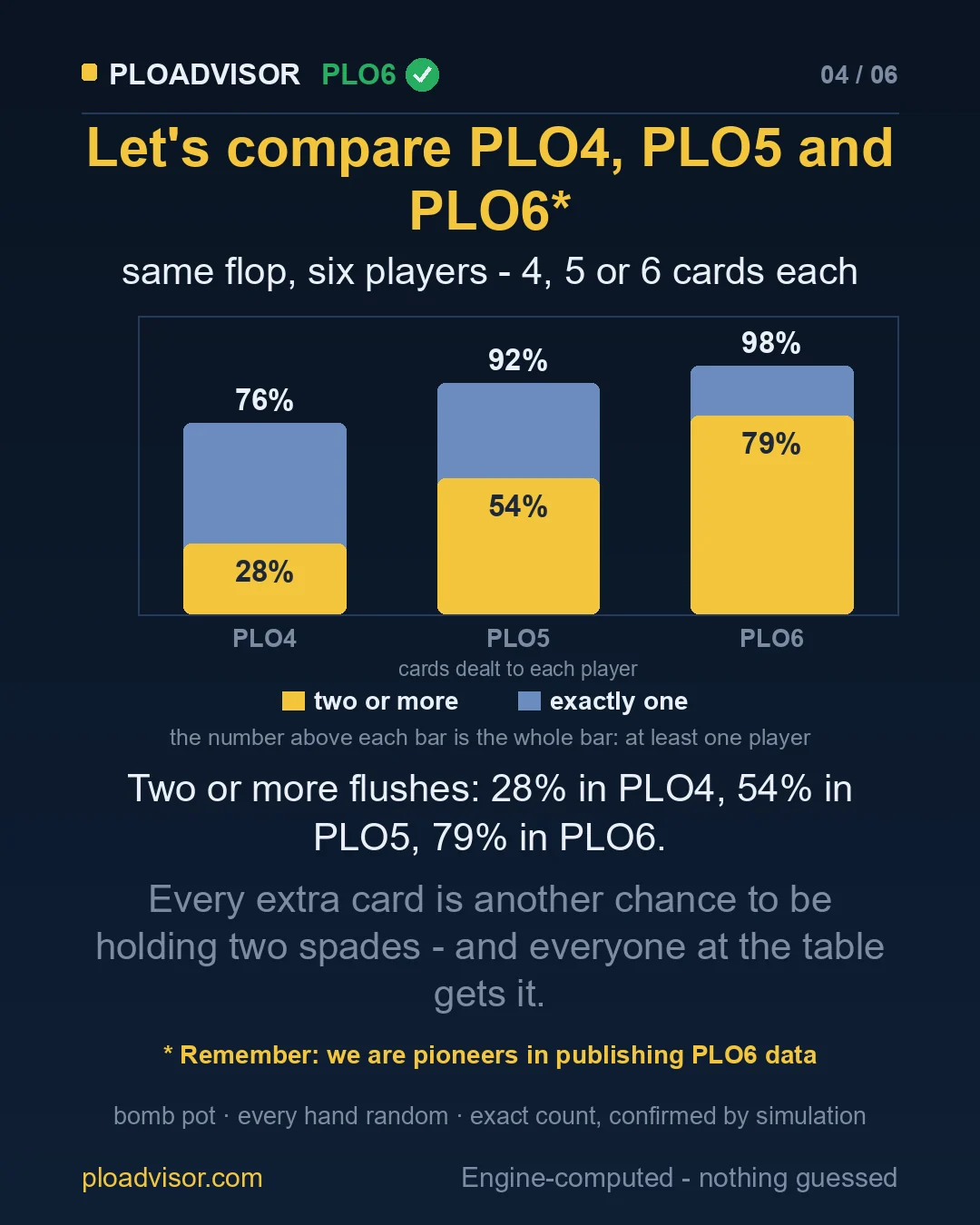
Same flop, six players — with four, five or six cards each. Take cards away from every hand and the count falls:
| Game (six players) | At least one | Exactly one | Two or more |
|---|---|---|---|
| PLO4 | 75.8% | 47.5% | 28.4% |
| PLO5 | 91.6% | 37.6% | 54.0% |
| PLO6 | 98.4% | 19.7% | 78.6% |
Two or more flushes: 28.4% in PLO4, 54.0% in PLO5, 78.6% in PLO6. Every extra card is another chance to be holding two spades (in Omaha a flush needs two suited cards from your hand) — and everyone at the table gets it. For how often a flush turns up by the river, see how often you will see a flush in PLO6.
It is not just flushes
Six players, PLO6, bomb pot, on one flop of each scary texture. The first number is how often a flop of that texture comes, counted over all 22,100 flops; the second is how often someone at the table already holds the hand, on that flop.
| Flop (texture) | Hand | How often the texture comes | Someone has it |
|---|---|---|---|
| Three of a suit A♠ K♠ 7♠ | someone has a flush | 5.18% | 98.4% |
| Open to a straight 9♦ 8♣ 7♥ | someone has a straight | 18.53% | 96.6% |
| Paired 9♣ 9♦ 2♥ | someone has a full house or better | 17.18% | 57.1% |
The scary flop is rare. The scary hand, once that flop is out, is not.
A full house is the highest bar of the three. On that same paired board, someone already has trips or better 94.9% of the time. (“Or better” means that hand or a stronger one: on this board, a player with both remaining nines has quads, and counts.)
The lesson
In a six-handed bomb pot, having it is not the question. Having the best one is. When two or more players show up with a flush 79% of the time, the hand stops being about whether you connected with the board — and starts being about which of you connected higher.
This article counts how many players hold a made hand. It does not measure who holds the best one.
How these numbers were produced
- Exact: every player figure is counted over every possible deal of the remaining 49 cards to the players (Omaha: exactly two cards from the hand, three from the board). On A♠ K♠ 7♠ a player has a flush when two or more of the ten remaining spades are in the hand; on 9♦ 8♣ 7♥, a straight; on 9♣ 9♦ 2♥, a full house or better and trips or better.
- Exact: how often each texture comes, counted over all 22,100 flops.
- Cross-check: a Monte Carlo simulation of 120,000 deals per question on all 16 questions measured for the post; the largest gap from the exact count is 2.7 standard errors of the simulation.
- Bomb pot: nobody folds before the flop, so every hand is a random hand.