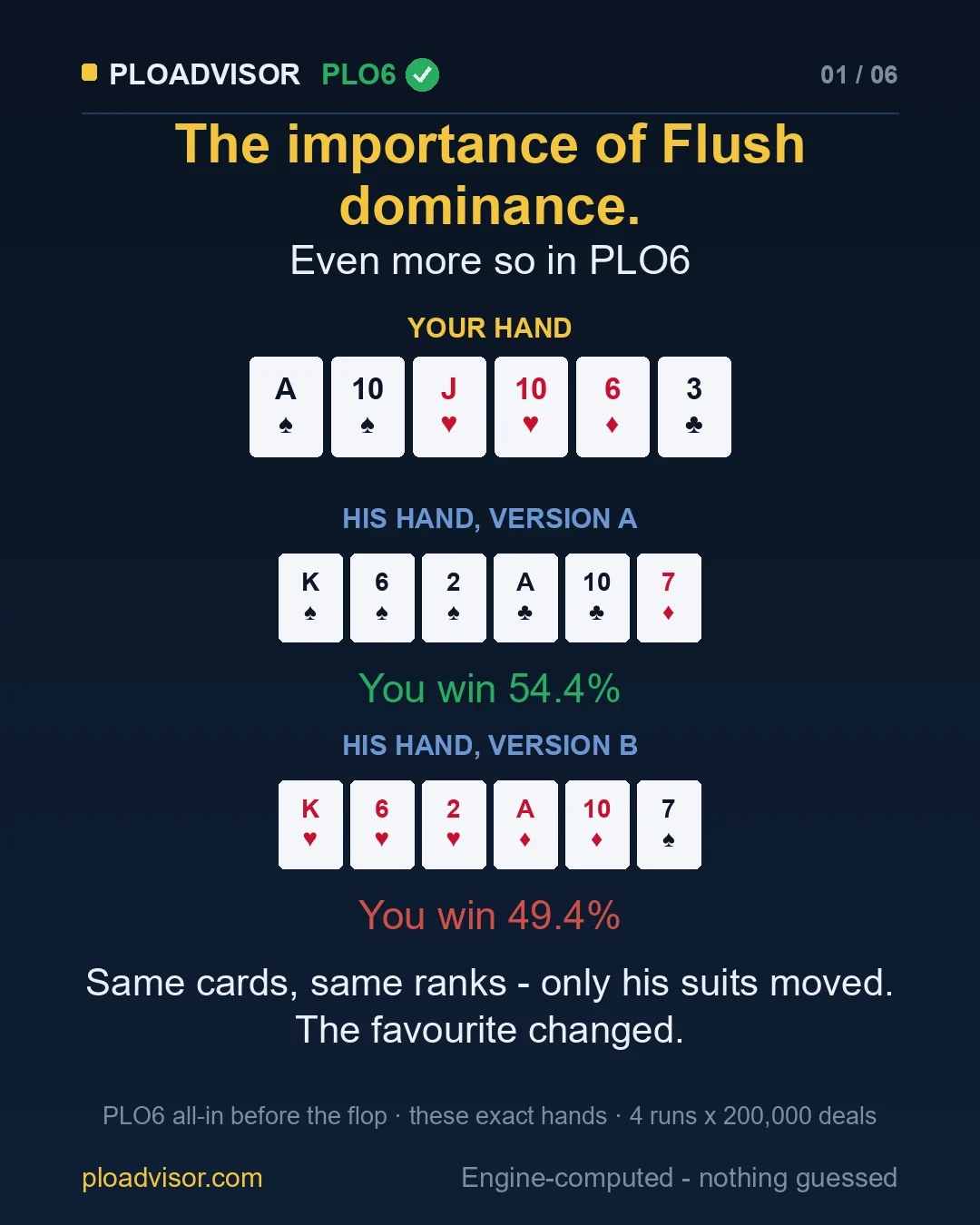
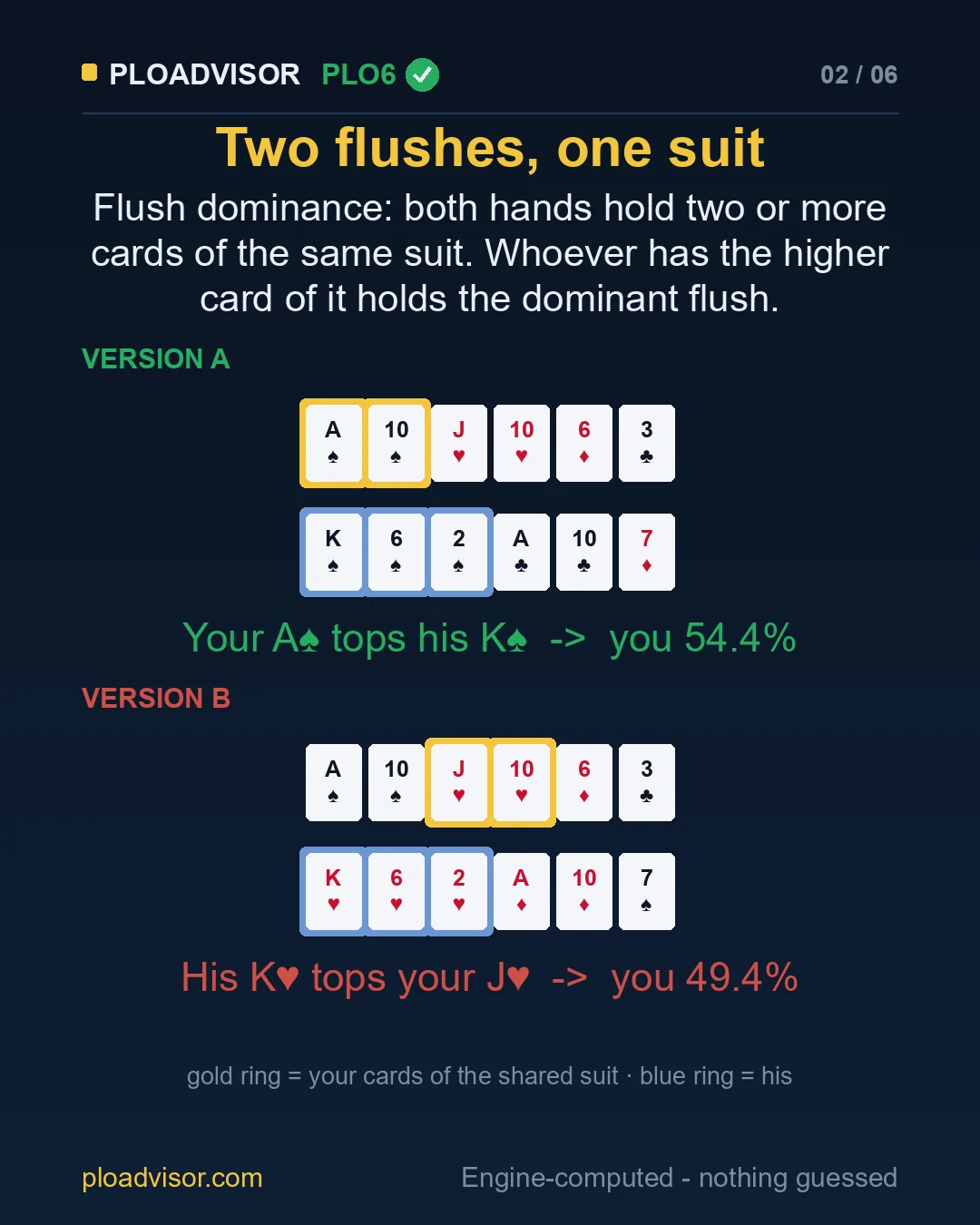
In a pre-flop all-in, two hands can hold two or more cards of the same suit. When they do, only one of them can make the higher flush in that suit — the one with the higher card of it. That is flush dominance, and it moves the equity enough to change the favourite: the same two PLO6 (six-card Pot-Limit Omaha) hands, with only the suits moved, give you 54.4% or 49.4%.
Key numbers
- Same ranks, same suit pattern, different suits: 54.4% in one arrangement, 49.4% in another.
- Across 300 PLO6 all-ins between top-30% hands, the favourite changed with the suits alone in 97.
- The first dominant flush is worth about 1.2 points of equity; each extra one, about 1 more.
- Two good (top-30%) PLO6 hands share a suit 79% of the time (PLO5 57%, PLO4 30%); two random PLO6 hands, 67% — and only PLO6 can share three suits at once.
Two flushes, one suit
Your hand: A♠ 10♠ J♥ 10♥ 6♦ 3♣. In version A his hand is K♠ 6♠ 2♠ A♣ 10♣ 7♦: you both hold ♠, and your A♠ tops his K♠ — you win 54.4%. In version B it is K♥ 6♥ 2♥ A♦ 10♦ 7♠: the same cards with the suits moved. Now you both hold ♥, his K♥ tops your J♥, and you win 49.4%.
One matchup, every suit arrangement
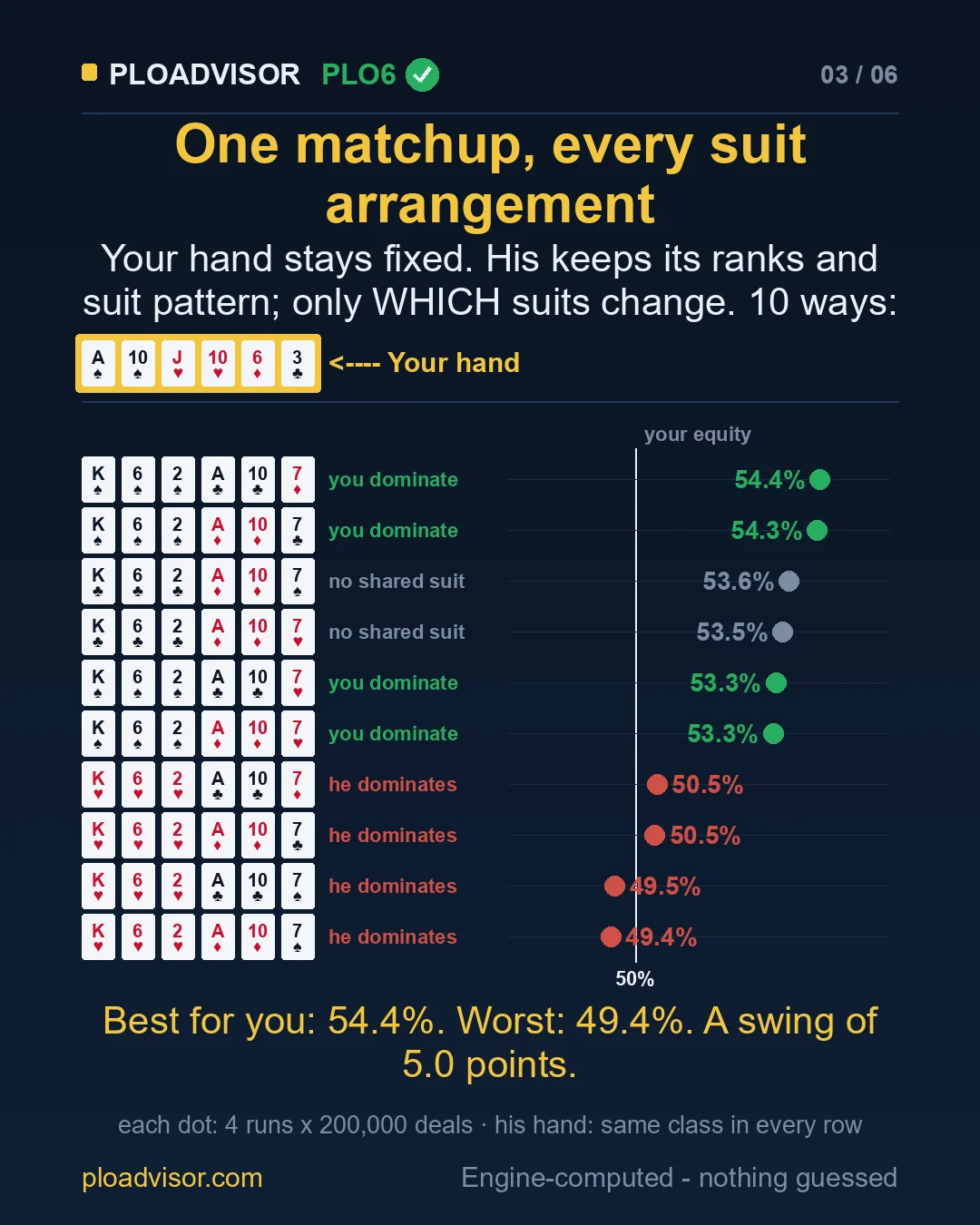
Keep your hand exactly as it is. His hand keeps its ranks and its suit pattern (three cards of one suit, two of another, one alone); only which suits it uses changes. Against your hand there are 10 such arrangements that do not reuse a card:
| His hand (same class in every row) | Flush dominance | Your equity |
|---|---|---|
| K♠ 6♠ 2♠ A♣ 10♣ 7♦ | you hold the dominant flush | 54.4% |
| K♠ 6♠ 2♠ A♦ 10♦ 7♣ | you hold the dominant flush | 54.3% |
| K♣ 6♣ 2♣ A♦ 10♦ 7♠ | no shared suit | 53.6% |
| K♣ 6♣ 2♣ A♦ 10♦ 7♥ | no shared suit | 53.5% |
| K♠ 6♠ 2♠ A♣ 10♣ 7♥ | you hold the dominant flush | 53.3% |
| K♠ 6♠ 2♠ A♦ 10♦ 7♥ | you hold the dominant flush | 53.3% |
| K♥ 6♥ 2♥ A♣ 10♣ 7♦ | he holds the dominant flush | 50.5% |
| K♥ 6♥ 2♥ A♦ 10♦ 7♣ | he holds the dominant flush | 50.5% |
| K♥ 6♥ 2♥ A♣ 10♣ 7♠ | he holds the dominant flush | 49.5% |
| K♥ 6♥ 2♥ A♦ 10♦ 7♠ | he holds the dominant flush | 49.4% |
Best for you: 54.4%. Worst: 49.4%. The gap between them — 5.0 points — is this matchup's swing. Each equity: 4 runs of 200,000 deals.
Not one matchup: 300
We drew 300 PLO6 matchups at random from the top 30% of hands (by real hands, not by hand classes), measured every suit arrangement of each, and kept its swing:
| Swing (points of equity) | Matchups |
|---|---|
| 0–1 | 31 |
| 1–2 | 26 |
| 2–3 | 24 |
| 3–4 | 50 |
| 4–5 | 50 |
| 5–6 | 61 |
| 6–7 | 27 |
| 7–8 | 18 |
| 8–9 | 6 |
| 9 or more | 7 |
The typical swing is 4.4 points; one matchup in ten swings more than 7.1. In 97 of the 300 the favourite changed with the suits. In the other 203 the same hand led in every arrangement: those matchups were further from a coin flip (typically 4.7 points away, against 1.2 for the ones that flipped) — more than the suits could move.
Who holds the dominant flush?
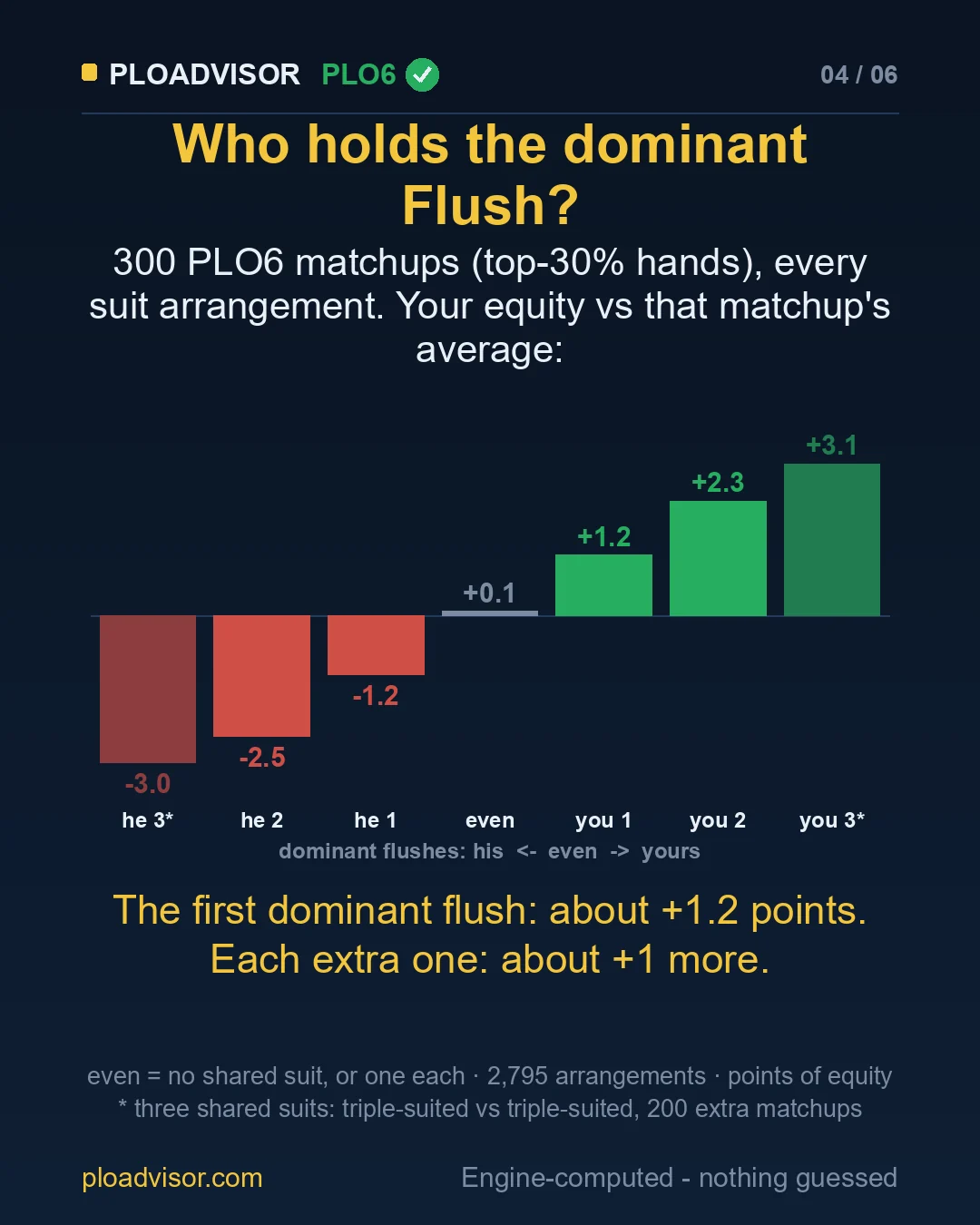
Every arrangement of every matchup, grouped by the shared suits each player dominates. Each value is your equity in that arrangement minus the average of the same matchup over all its arrangements:
| Arrangement | Your equity vs the matchup's average (points) | Arrangements |
|---|---|---|
| No shared suit | +0.0 | 584 |
| One shared: you dominate | +1.2 | 804 |
| One shared: he dominates | -1.2 | 868 |
| Two shared: you dominate both | +2.3 | 102 |
| Two shared: one each | +0.1 | 325 |
| Two shared: he dominates both | -2.5 | 95 |
| Three shared: you dominate all three* | +3.1 | 16 |
| Three shared: you 2, he 1* | +1.5 | 153 |
| Three shared: you 1, he 2* | -1.2 | 194 |
| Three shared: he dominates all three* | -3.0 | 42 |
No shared suit, or one each, and the suits cancel out. The first dominant flush is worth about 1.2 points; each extra one adds about 1 more.
* Three shared suits need three suited pairs in both hands, so they are rare (0.6% of the arrangements in our 300 random matchups). Those rows come from a separate, targeted sample: 200 matchups between triple-suited hands. “You dominate all three” appeared in only 16 arrangements there — the direction is clear, the exact value is the least precise number on this page.
In PLO6, flush dominance is much more common
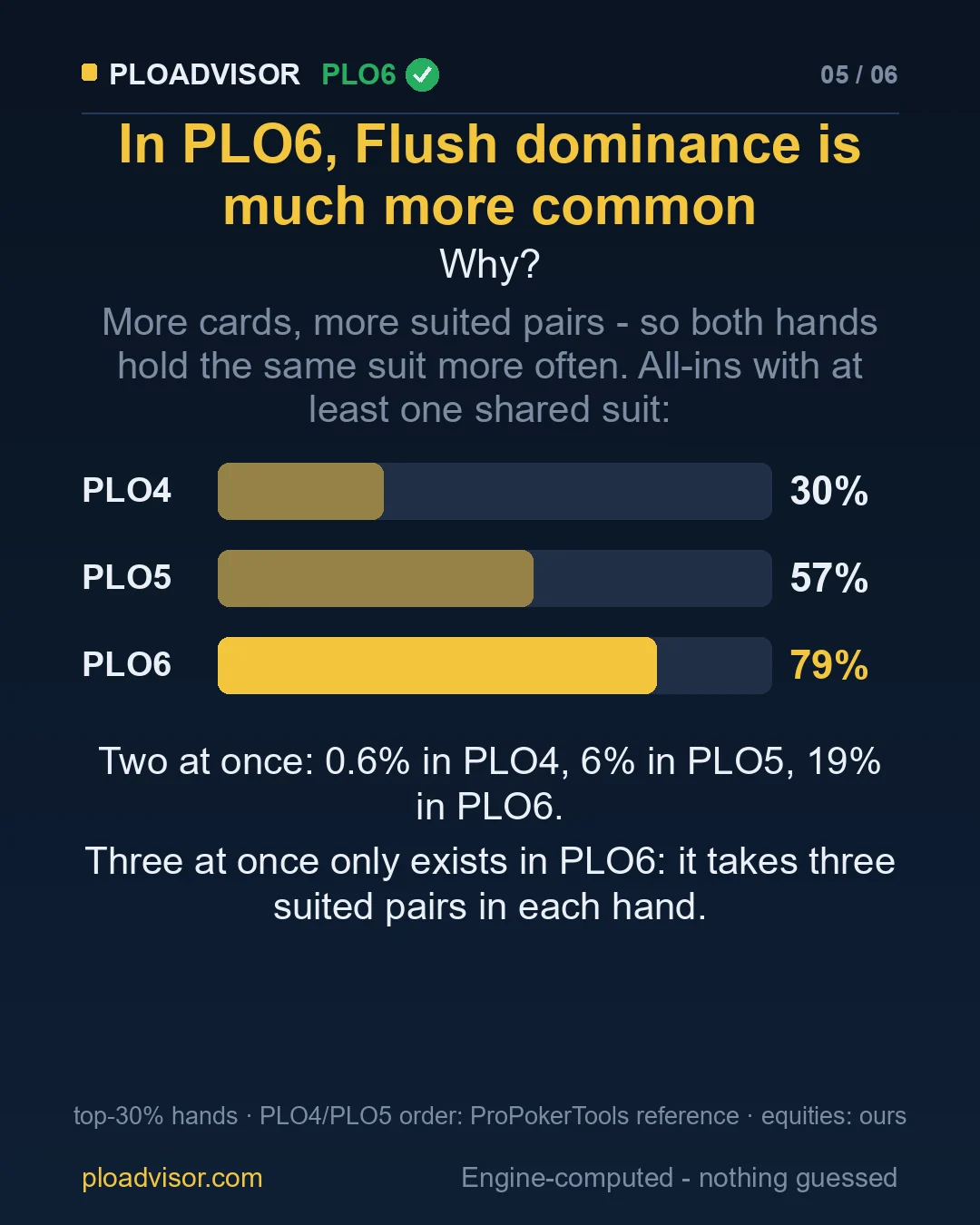
More cards mean more suited pairs, so both hands hold the same suit more often:
| PLO4 | PLO5 | PLO6 | |
|---|---|---|---|
| Two random hands share a suit (exact) | 22% | 44% | 67% |
| Two top-30% hands share a suit (every suit arrangement) | 30% | 57% | 79% |
| same, each matchup counted once | 29% | 54% | 78% |
| With two shared suits | 0.6% | 6.2% | 19.3% |
| With three shared suits | 0.0% | 0.0% | 0.6% |
| Typical swing from suits alone (points) | 2.9 | 4.0 | 4.4 |
| Typical distance from 50/50 (points) | 5.8 | 4.0 | 3.4 |
| Favourite changes, among matchups within 5 points of 50/50 | 37 of 84 | 55 of 114 | 97 of 208 |
Which hands, exactly? The 79% is not about any two hands. Deal two random PLO6 hands and they share a suit 67% of the time (an exact count). Between two good hands — our top-30% sample — it rises to 79%: good PLO6 hands tend to be more suited, so they collide in the same suit more often. That number is a frequency of dealt hands, not of any action; the all-in part of this article is the equity, measured by running the hands out to the river. Counting each matchup once instead of each suit arrangement gives 78% — either way, almost four times out of five.
We do not compare how often the favourite changes from game to game. PLO6 all-ins sit closer to 50/50 (last rows), which by itself makes a flip easier; among matchups within 5 points of 50/50, the favourite changes about as often in all three games. What PLO6 changes is how often a suit is shared at all.
What this does not measure
- Blockers. A single card of your suit in his hand (not enough for his own flush) also changes your odds. It is not part of the dominance count; in PLO6 matchups with no shared suit in any arrangement, the swing was small (typically 0.5 points, 17 matchups).
- Heads-up, all-in before the flop. Both hands see all five cards. With betting after the flop, or more players, the numbers change.
- Top-30% hands. The matchups were drawn from each game's top 30%. For PLO4 and PLO5 that order comes from ProPokerTools' reference ranking; every equity on this page is ours.
How these numbers were produced
- Simulated: every equity is Monte Carlo. The example matchup: 4 runs of 200,000 deals per arrangement. The 300 matchups: 100,000 deals per arrangement, and each matchup's best and worst arrangements were re-run 3 times with new seeds, so picking the extremes does not inflate the swing.
- Exact: which arrangements exist, and who holds the higher card of each shared suit, is counted card by card.