6-card Omaha — PLO6 — is Pot-Limit Omaha with six hole cards instead of four. The rules do not change: you still make your hand with exactly two of your cards and exactly three from the board. What changes is almost everything else: how many hands exist, how often flushes and Aces show up, how much suits and connectedness are worth, and how close all-ins run to a coin flip. This page collects what we have measured, with a link to the full breakdown of each point.
PLO6 in five numbers
- 20,358,520 starting hands — 15,353 times Hold'em — in 962,988 distinct hand classes. Details →
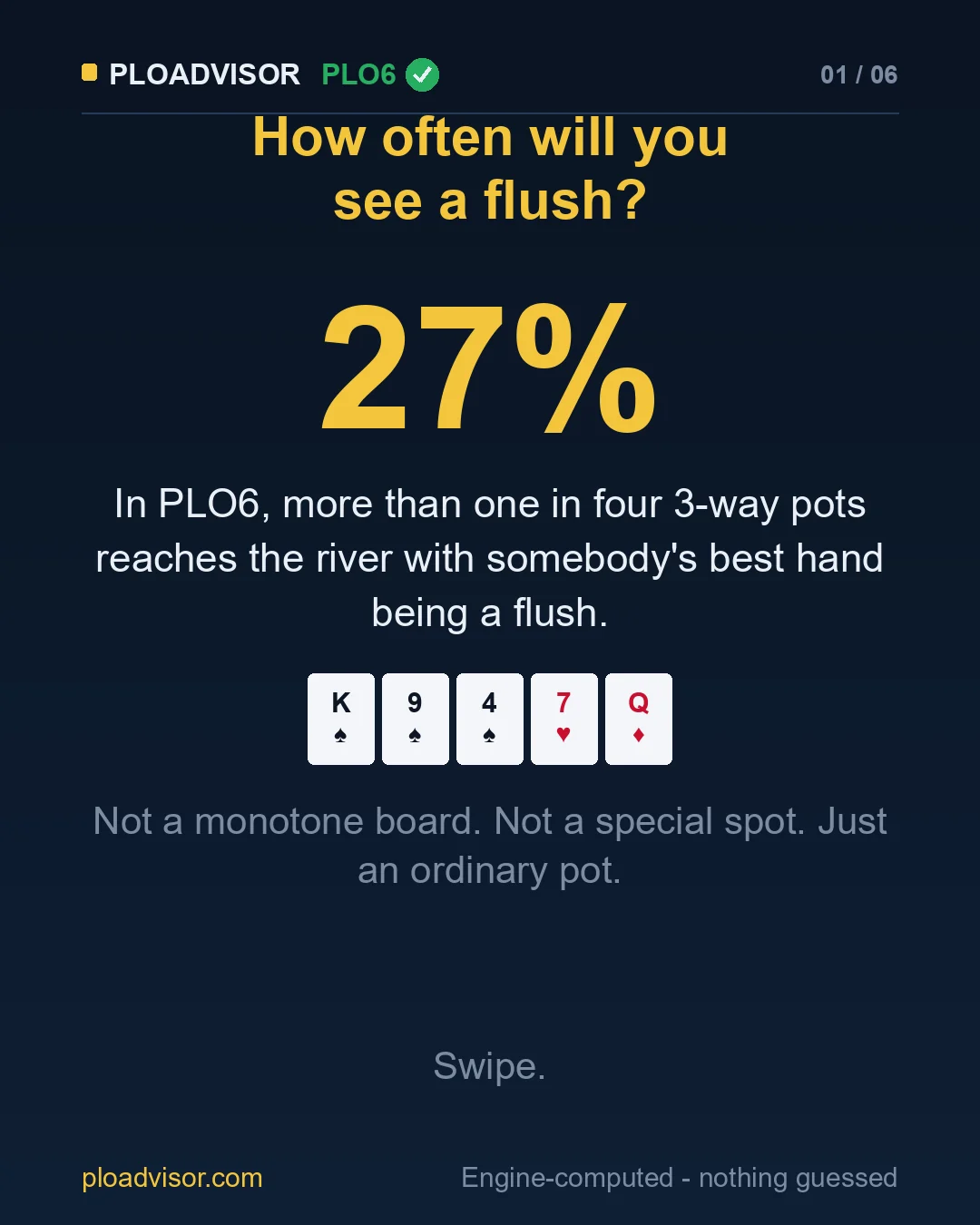
- Three-way, someone's best hand is exactly a flush 27% of the time by the river (PLO4: 18%). Details →
- At a 6-max table, somebody was dealt Aces 35.2% of the time (PLO4: 15.2%). Details →
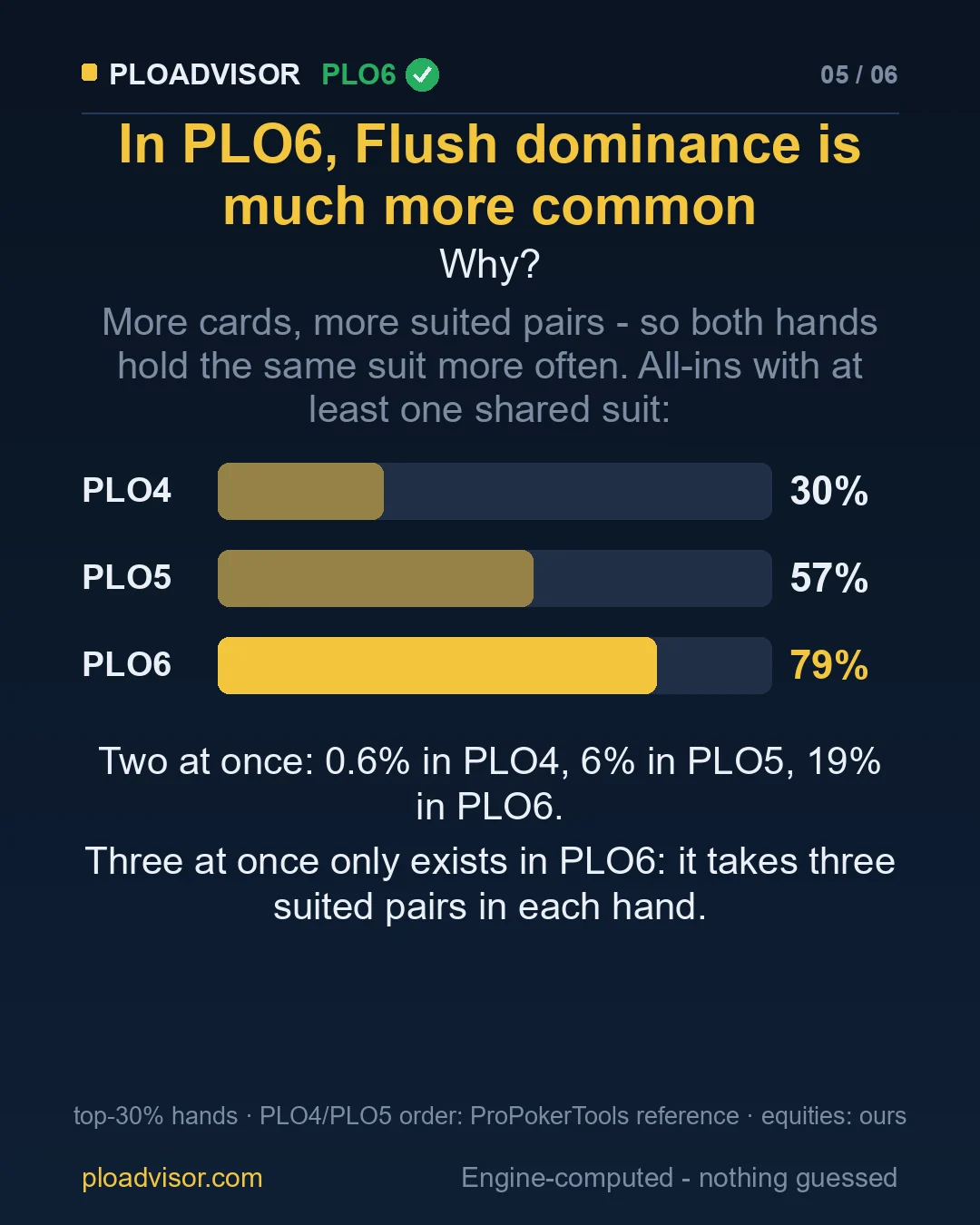
- In 79% of all-ins between good hands, both players hold the same suit (PLO4: 30%) — and the higher card of it can change the favourite. Details →
- A gap in your hand costs an A-high hand about 12 percentile points (five gaps) and a Q-high hand about 53. Details →
The rules: same game, more cards
Each player receives six cards. Betting is pot-limit, as in PLO4. At showdown you must use exactly two hole cards and three board cards — so with six cards you choose among 15 two-card pairs, and by the river each player has 150 possible five-card hands (PLO4: 60). A six-card hand that “looks” like it has a flush or a straight only has one if two of its cards make it with the board.
How many starting hands?
| Game | Hole cards | Starting hands | Hand classes |
|---|---|---|---|
| Hold'em | 2 | 1,326 | 169 |
| PLO4 | 4 | 270,725 | 16,432 |
| PLO5 | 5 | 2,598,960 | 134,459 |
| PLO6 | 6 | 20,358,520 | 962,988 |
A hand class groups hands that play identically once you ignore which suit is which. Nobody memorises 962,988 of them, which is why a ranking of every class is the starting point for PLO6 decisions. How many starting hands each PLO has →
What changes when you go from four cards to six
| PLO4 | PLO5 | PLO6 | |
|---|---|---|---|
| Someone's best hand is exactly a flush (3-way, by the river) | 18% | 23% | 27% |
| Someone at a 6-max table was dealt Aces | 15.2% | 24.5% | 35.2% |
| All-ins where both hands hold the same suit (top-30% hands) | 30% | 57% | 79% |
| Typical distance of those all-ins from 50/50 (points) | 5.8 | 4.0 | 3.4 |
Each row is measured in its own article; the sections below summarise them.
Flushes are everywhere
With six cards you hold more suited pairs, so flushes arrive more often — three-way, someone's best hand is exactly a flush 27% of the time in PLO6, against 18% in PLO4 — and the flush is not the only thing on the board: rivers that allow a flush are often paired too, which is where full houses come from. How often will you see a flush? →
Aces show up more often — and depend on what's next to them
You are dealt a pair of Aces once every 16.4 hands in PLO6 (once every 39 in PLO4), and at a 6-max table somebody has them 35.2% of the time. The Aces themselves are not the hand: the same A♠A♥ ranks Top 0.02% suited to broadway cards, Top 6.14% suited to junk and Top 52% suited to nothing. Who has Aces → Why suited Aces matter →
Suits decide more all-ins: flush dominance
When both hands hold two or more cards of the same suit, whoever has the higher card of it holds the dominant flush. In PLO6 that happens in 79% of all-ins between top-30% hands (PLO5 57%, PLO4 30%), and across 300 measured matchups the favourite changed with the suits alone in 97. Flush dominance in PLO6 →
Gaps cost more when the top card is lower
Connectedness matters, but its price depends on the high card and the suits. Five gaps cost the typical double-suited A-high hand about 12 percentile points, a K-high hand about 33 and a Q-high hand about 53; more suited pairs make each gap cheaper. What a gap costs →
All-ins run closer to a coin flip
With more cards, hands are more alike: between top-30% hands, PLO6 all-ins sit typically 3.4 points from 50/50, against 5.8 in PLO4. Big edges before the flop are rarer, and what separates hands is often a detail — a suit, a gap, a blocker. One card, a hundred thousand places →
Multiway pots and bomb pots
Even a top PLO6 hand loses ground fast as opponents are added: from 66.2% heads-up against a random hand to 34.4% against five. In a six-player bomb pot on a monotone flop, the most likely number of players already holding a flush is not zero or one — it is two (46.6%). Bomb pot equity → Who already has a flush? →
Opening ranges
A calibrated reference frequency for PLO6 has the Button opening about the top 45% of hands at a 6-max table. A percentage is only useful if you can place your own hand in it — which is what a complete ranking of the 962,988 classes is for. Is this hand an open from the Button? →
Where to start
- Hand strength before the flop: Suited Aces · Aces and broadways · The price of a gap · Suit distribution
- How often things happen: Flushes · Aces at the table · Starting hands
- At the table: Flush dominance · Button opening range · Bomb pots
- Flop play: Nut advantage on the flop · Reading the equity curve