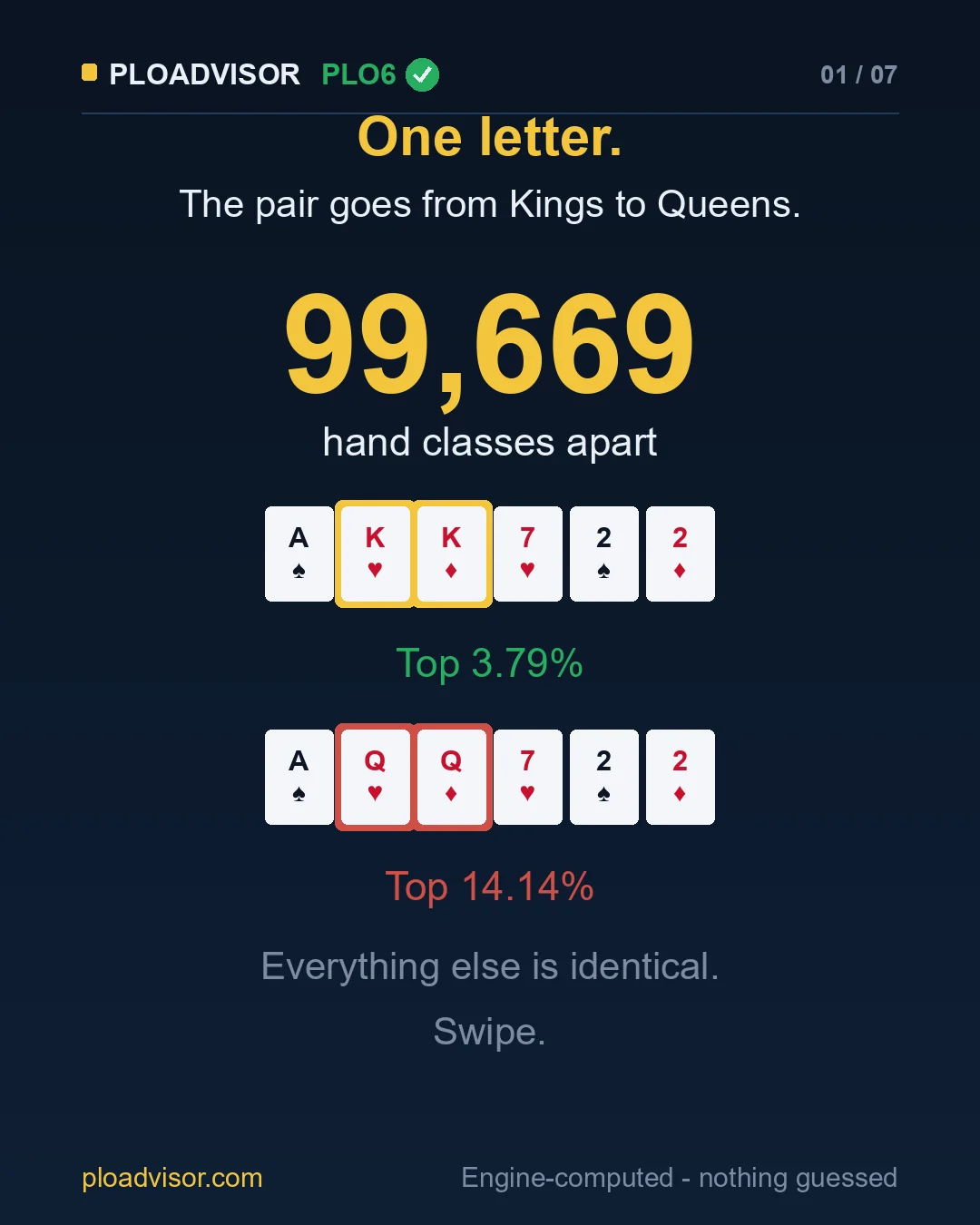
Take two PLO6 (six-card Pot-Limit Omaha) hands with the same four side cards — the very same A♠ 7♥ 2♠ 2♦, same suits — and change only the pair, from Kings to Queens. In our playability ranking they end up 99,669 hand classes apart: Top 3.79% against Top 14.14%.
Key numbers
- A♠ K♥ K♦ 7♥ 2♠ 2♦: Top 3.79% (rank 36,467). A♠ Q♥ Q♦ 7♥ 2♠ 2♦: Top 14.14% (rank 136,136).
- 99,669 hand classes between them — about 10% of all 962,988 PLO6 hand classes.
- All-in against each other before the flop: about 68 / 32. The Queens version is a 2‑to‑1 underdog to its own twin.
- Walking the pair down from Kings to Nines, each step costs less than the last — until Ten to Nine, which costs 10.2 points again.
Two hands, one letter apart
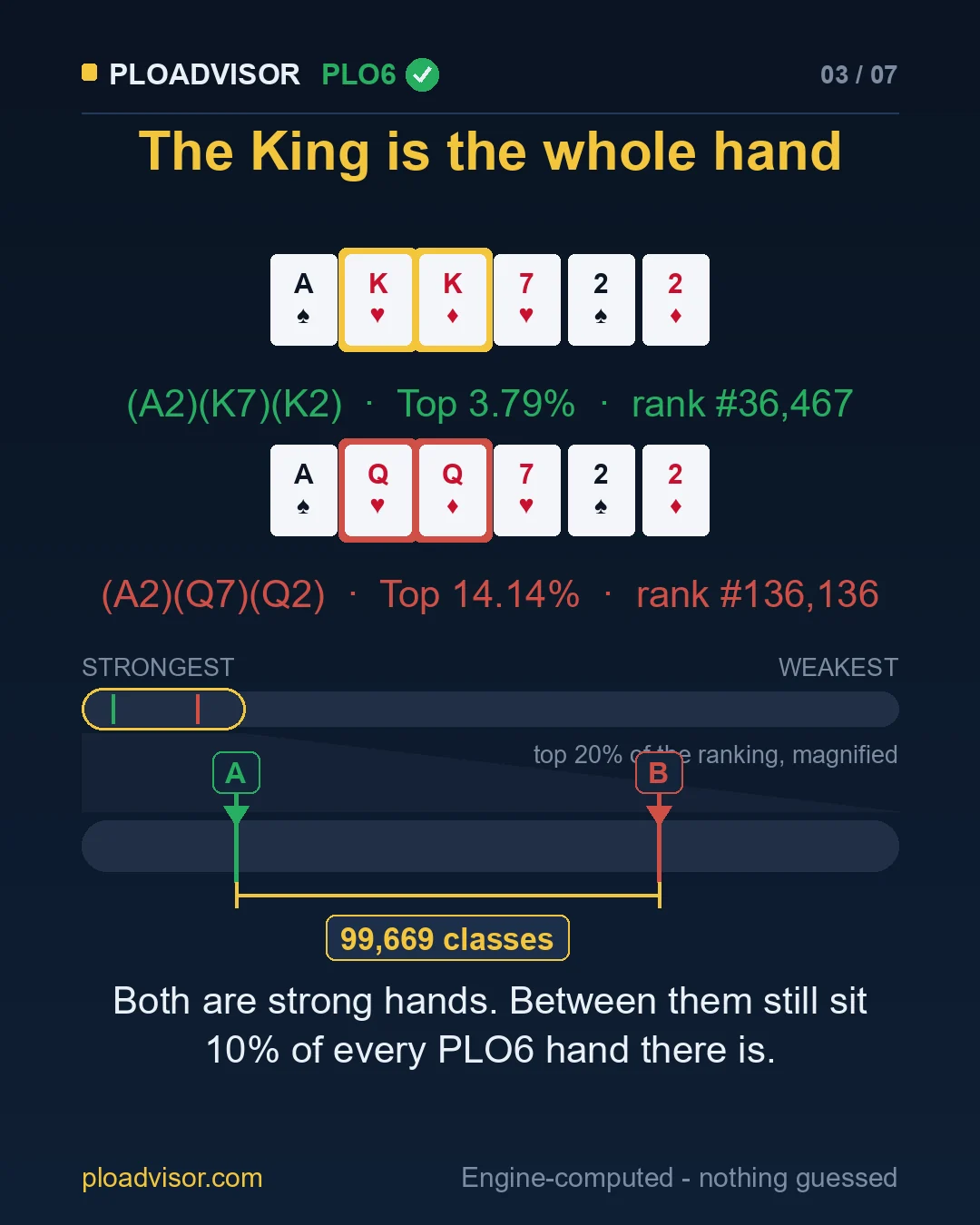
The two hands differ only in the pair: K–K in one, Q–Q in the other, on the same suits. The ace, the seven and the two deuces are the exact same four cards. Here is where each lands in the ranking — its percentile is the rank divided by the 962,988 hand classes of PLO6:
| Hand | Cards | Class | Rank | Percentile |
|---|---|---|---|---|
| Hand A (Kings) | A♠ K♥ K♦ 7♥ 2♠ 2♦ | (A2)(K7)(K2) | 36,467 | Top 3.79% |
| Hand B (Queens) | A♠ Q♥ Q♦ 7♥ 2♠ 2♦ | (A2)(Q7)(Q2) | 136,136 | Top 14.14% |
Both are strong hands. Between them still sit 99,669 hand classes — about 10% of every PLO6 hand class there is.
Now put them all-in
A different question, with a different number: the two hands against each other, all-in before the flop. This is equity head-to-head, not a ranking — so it is worth keeping the two apart. The ranking asks where a hand sits against the whole field, across all streets and multiway; the all-in asks how one hand does against one other hand.
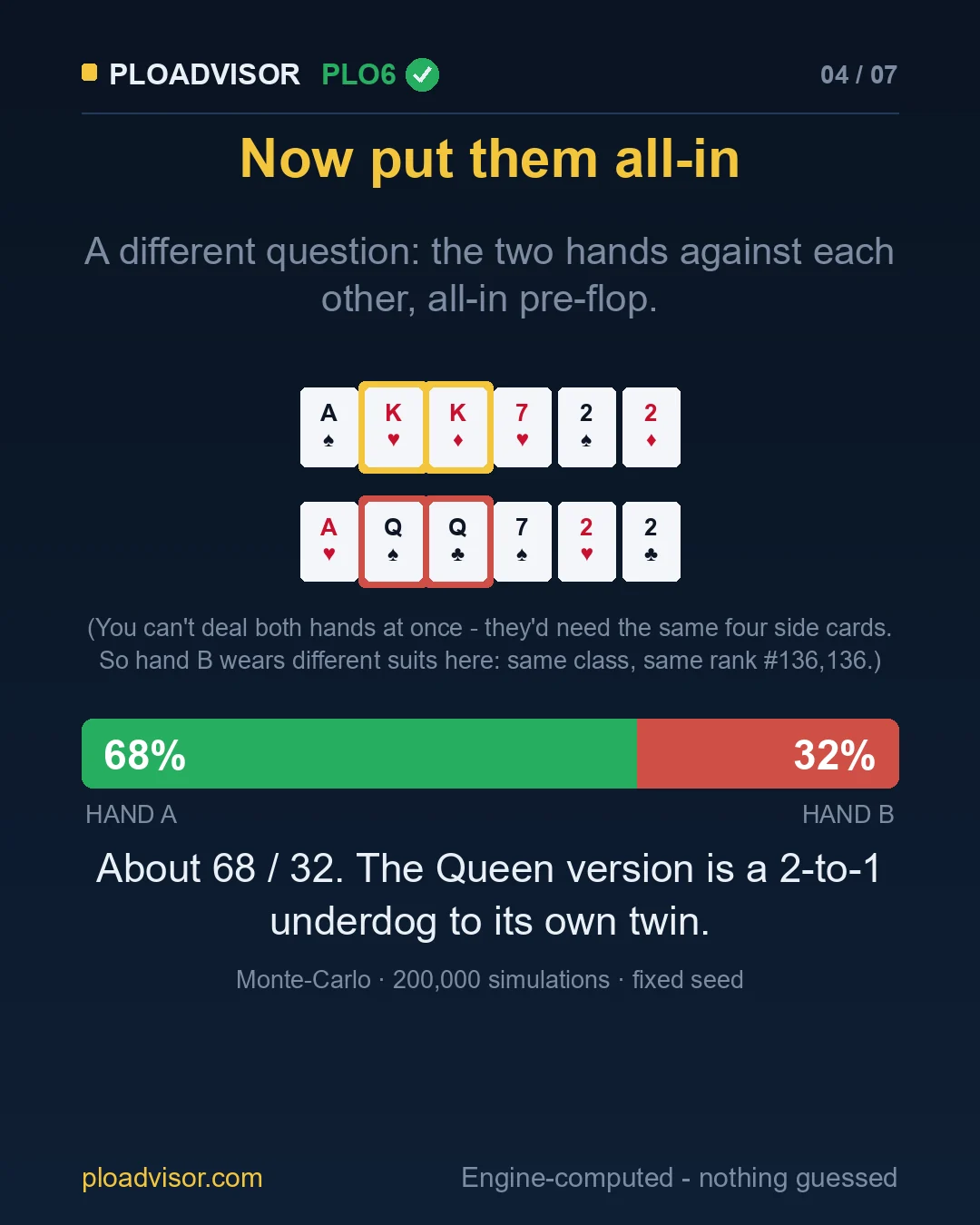
You can’t deal both hands at once: they would need the same four side cards. So for this matchup hand B wears different suits — A♥ Q♠ Q♣ 7♠ 2♥ 2♣ — which is the same hand class, with the same rank (136,136).
| All-in before the flop | Equity |
|---|---|
| Hand A — A♠ K♥ K♦ 7♥ 2♠ 2♦ | about 68% |
| Hand B — A♥ Q♠ Q♣ 7♠ 2♥ 2♣ | about 32% |
About 68 / 32. The two numbers answer different questions and tell the same story.
Why the pair rules: walk it down
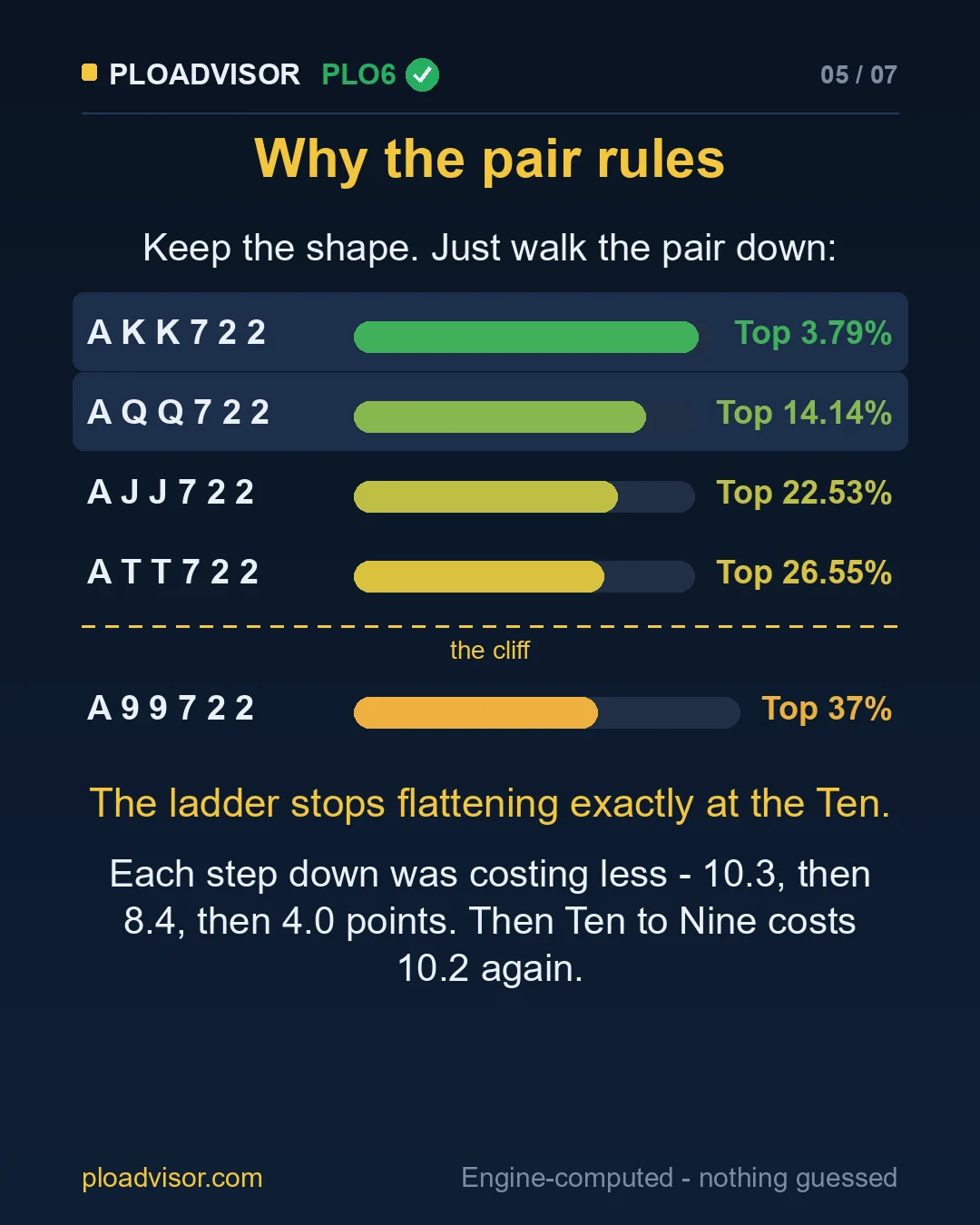
Keep the shape of the hand and move only the pair, from Kings down to Nines:
| Pair | Cards | Rank | Percentile | Points lost vs pair above |
|---|---|---|---|---|
| Kings | A♠ K♥ K♦ 7♥ 2♠ 2♦ | 36,467 | Top 3.79% | – |
| Queens | A♠ Q♥ Q♦ 7♥ 2♠ 2♦ | 136,136 | Top 14.14% | 10.3 |
| Jacks | A♠ J♥ J♦ 7♥ 2♠ 2♦ | 217,004 | Top 22.53% | 8.4 |
| Tens | A♠ 10♥ 10♦ 7♥ 2♠ 2♦ | 255,634 | Top 26.55% | 4.0 |
| Nines | A♠ 9♥ 9♦ 7♥ 2♠ 2♦ | 354,103 | Top 37% | 10.2 |
Each step down was costing less — 10.3, then 8.4, then 4.0 points. Then Ten to Nine costs 10.2 again. The ladder stops flattening exactly at the Ten.
So what is going on?
We went looking for the reason behind that step at the Ten. Three things we checked:
- Not a glitch. The same cliff shows up in a second, independently computed ranking.
- It needs an ace. Build the same ladder in a hand with no ace and the cliff disappears; the steps just grow gradually.
- It is not straight count. How often the hand makes a straight barely moves: in a simulation of 150,000 deals, about 8.9% of the time with the Ten and 8.4% with the Nine. Nowhere near enough to explain a 10-point fall.
Our best guess: A + 10 still makes Broadway — the nuts. A + 9 makes no straight with the ace at all. So maybe it isn’t how many straights you make, but whether they’re the ones that win. We haven’t proved that.
What it means at the table
In PLO6 there is no such thing as a small difference. With six cards the hands all start to look alike, and the eye stops being able to tell them apart. These two are 99,669 classes and a 2‑to‑1 all-in apart. That is why we ranked all 962,988 of them.
How these numbers were produced
- Ranking: Playability, 6-max, our PLO6 ranking over all 962,988 hand classes — see how we built it. The ranking is estimated by simulation.
- Precision: deeper in the ranking the estimates are less precise, which is why the Nines hand is shown without decimals (Top 37%). The step from Ten to Nine is 10 points, not a difference of a few points in the tail.
- Classes, not hands: a percentile counts hand classes, and every class counts once, however many concrete hands it stands for.
- All-in: Monte Carlo, 200,000 simulations, fixed seed.
- Straight frequency: Monte Carlo, 150,000 deals per hand: how often the hand ends with a straight as its best five-card hand by the river. Being a simulation, it can move slightly from one run to the next.