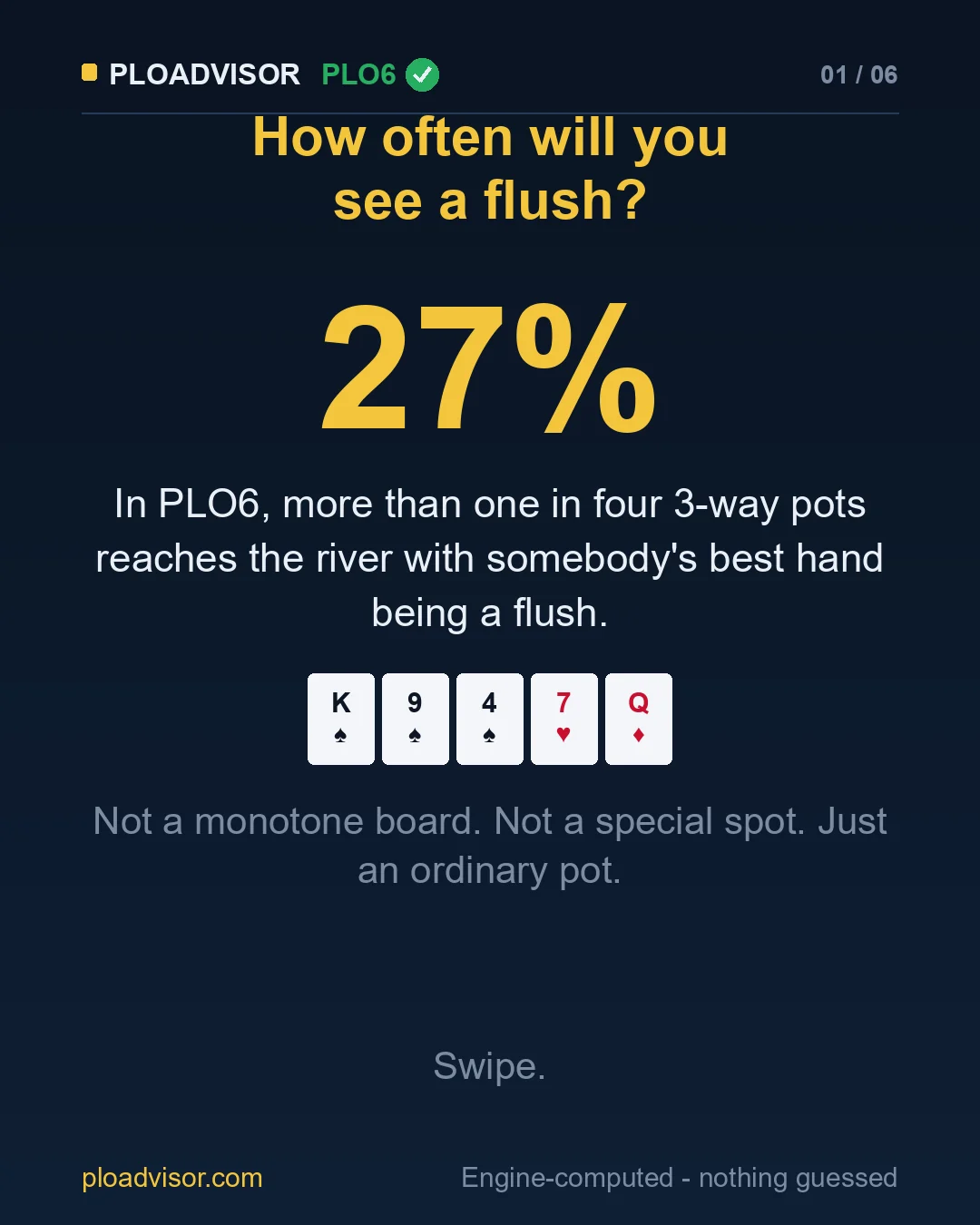
In a 3-way PLO6 (six-card Pot-Limit Omaha) pot with random hands, more than one pot in four — 27% — reaches the river with somebody’s best hand being a flush. Not a monotone board, not a special spot: an ordinary pot. And the boards where it happens are very often boards where a full house is possible too — a flush is not the nuts there.
Key numbers
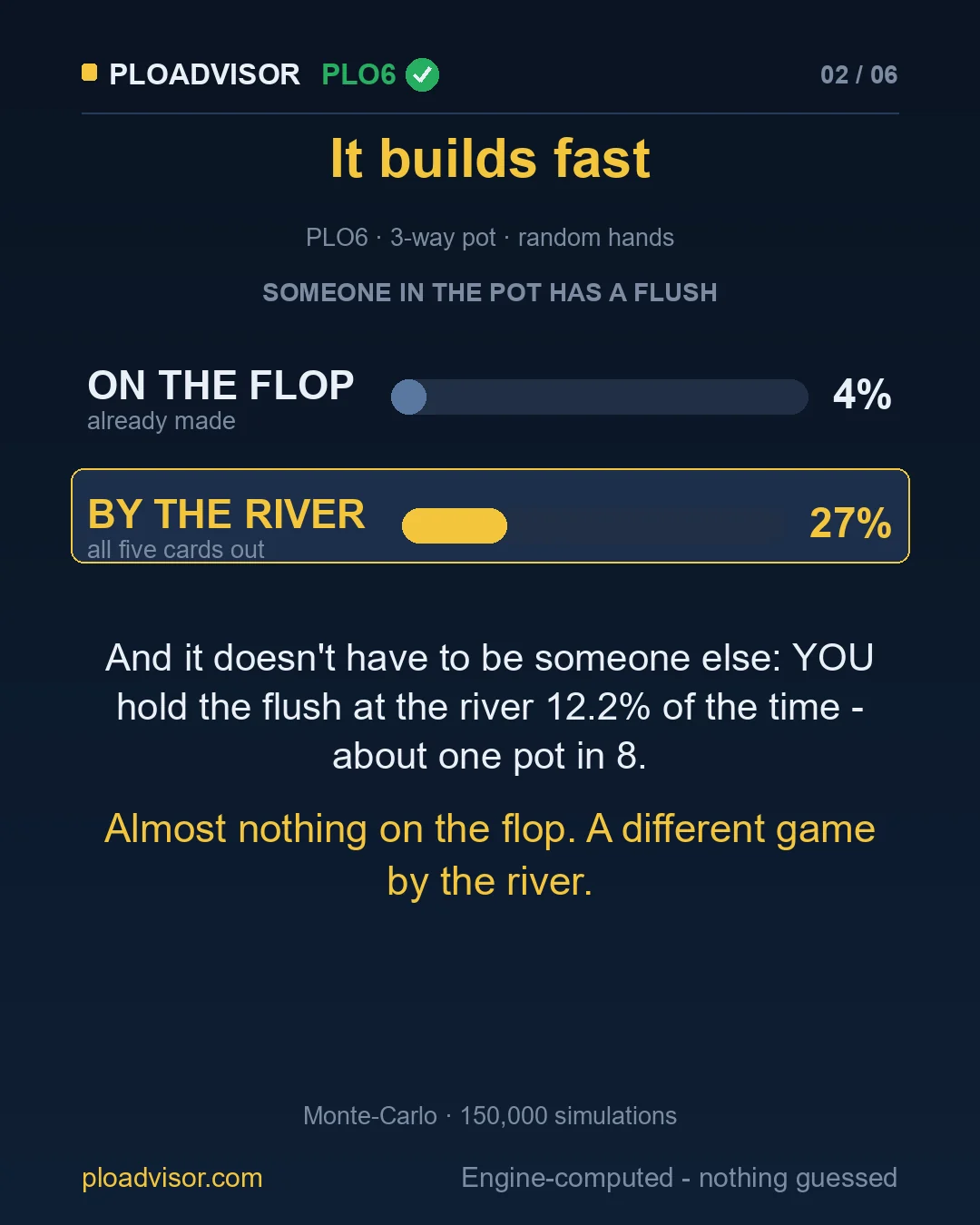
- PLO6, 3-way, by the river: someone’s best hand is exactly a flush 27% of the time; on the flop, 4%.
- You yourself hold it 12.2% of the time — about one pot in 8.
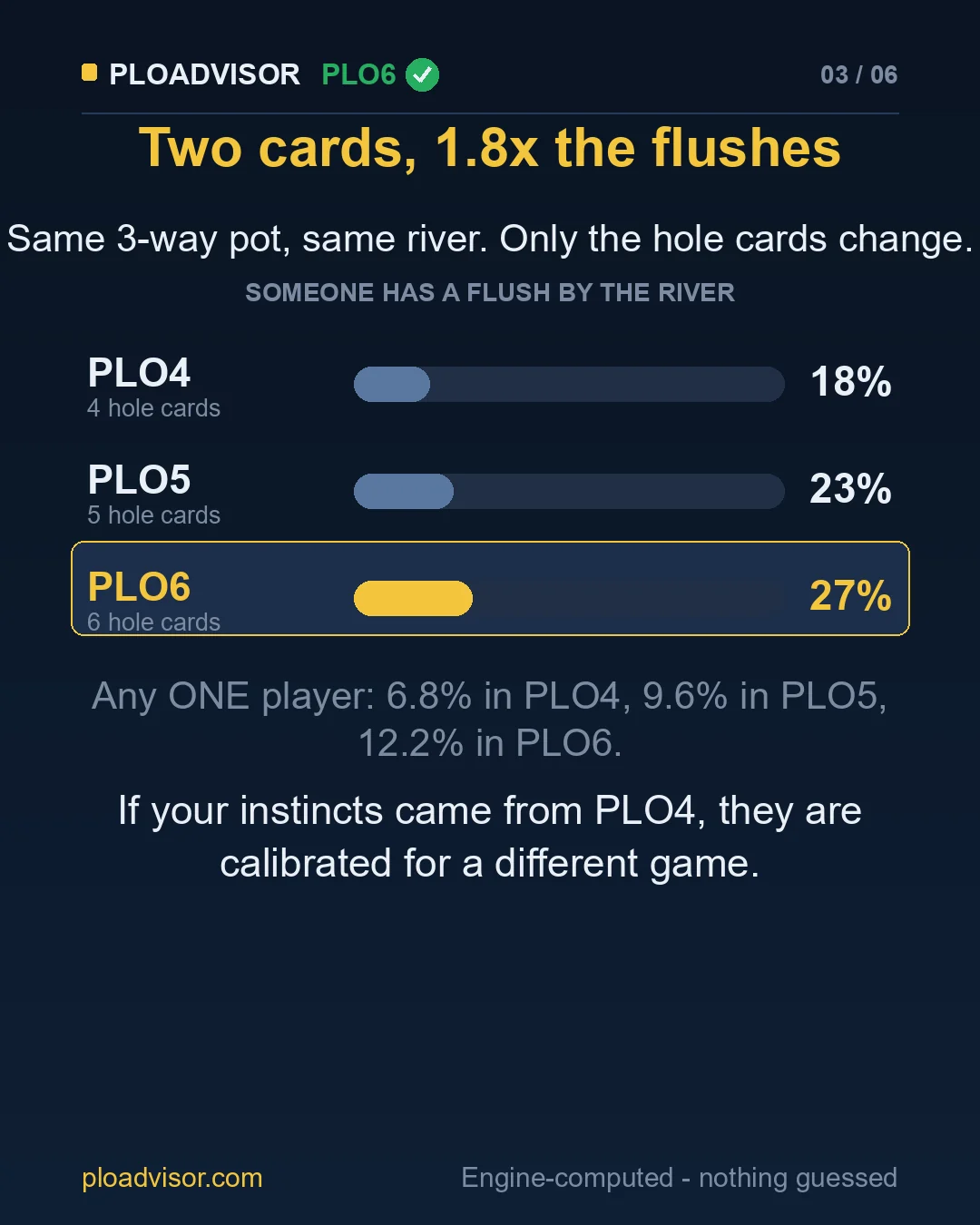
- Same pot, fewer hole cards: PLO4 18% · PLO5 23% · PLO6 27%. Per player, PLO6 makes the flush 1.8x as often as PLO4.
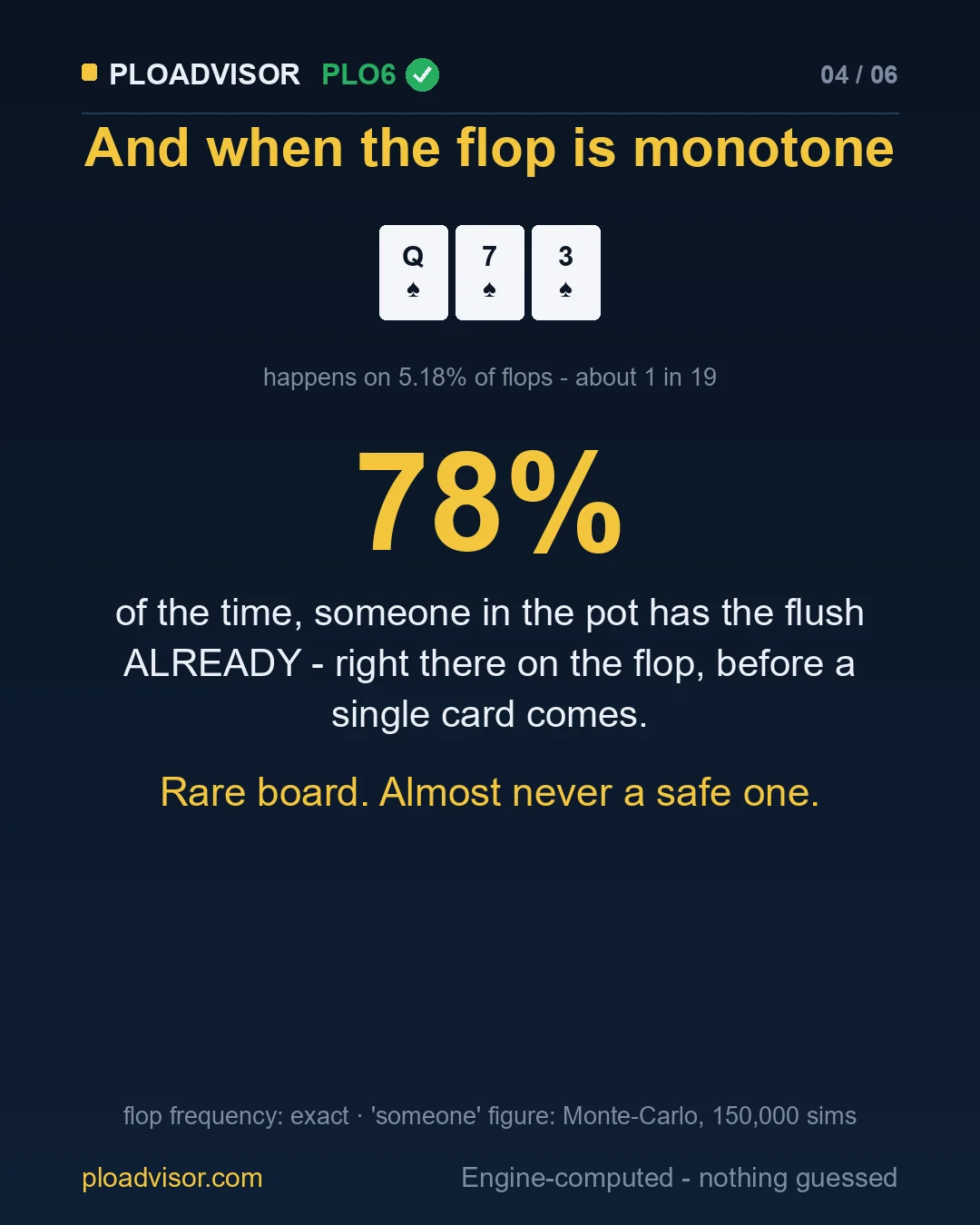
- Monotone flop (5.18% of flops, about 1 in 19): someone already has the flush 78% of the time.
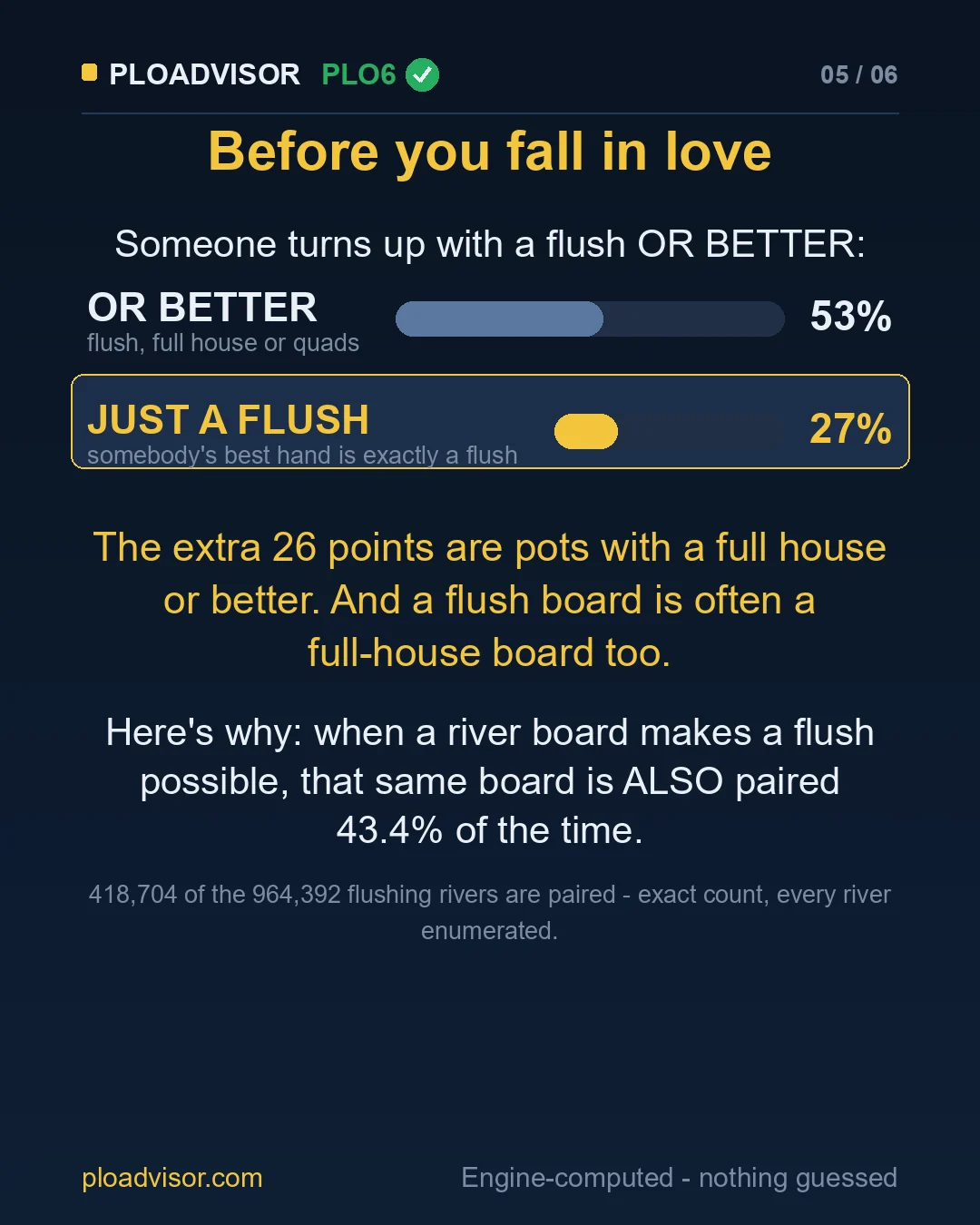
- Flush or better: 53%. The extra 26 points are pots with a full house or better. And 43.4% of the river boards that allow a flush are also paired (exact).
It builds fast: flop to river
Take 3 random PLO6 hands; the question is whether anyone’s best five-card hand is a flush:
| PLO6, 3-way pot | Someone has a flush |
|---|---|
| On the flop (already made) | 4% |
| By the river (all five cards out) | 27% |
Almost nothing on the flop. A different game by the river. And it doesn’t have to be someone else: you hold the flush at the river 12.2% of the time — about one pot in 8.
PLO4, PLO5 and PLO6: same pot, more hole cards
Same 3-way pot, same river. Only the number of hole cards changes:
| Game | Hole cards | Someone has a flush by the river | Any one player |
|---|---|---|---|
| PLO4 | 4 | 18% | 6.8% |
| PLO5 | 5 | 23% | 9.6% |
| PLO6 | 6 | 27% | 12.2% |
Per player, two extra hole cards take the flush from 6.8% to 12.2% — about 1.8x. In Omaha a flush needs two cards of one suit in your hand (a suited pair), and six cards give every hand more ways to hold one. If your instincts came from PLO4, they are calibrated for a different game.
And when the flop is monotone
A monotone flop — all three cards of one suit — happens on 5.18% of flops, about 1 in 19 (exact count). On the monotone flop Q♠ 7♠ 3♠, in the same 3-way pot, someone has the flush already 78% of the time — right there on the flop, before a single card comes. Rare board. Almost never a safe one.
“Flush” or “flush or better”?
The two questions sound alike and give very different answers. Everything above counts pots where someone’s best hand is exactly a flush. Ask how often someone shows up with a flush or better, and the answer jumps:
| PLO6, 3-way, by the river | How often |
|---|---|
| Someone’s best hand is a flush or better (flush, full house or quads) | 53% |
| Someone’s best hand is exactly a flush | 27% |
| The gap: full houses and better | 26 points |
The extra points are pots where someone has a full house or better and nobody’s best hand is just a flush. So the gap does not count flushes that got beaten — how often a flush loses is a different question, and these numbers do not answer it. What the board does show is how exposed a flush is: when a river board makes a flush possible, that same board is also paired 43.4% of the time, and a paired board is what makes a full house possible.
| River boards (all of them) | Boards | Share |
|---|---|---|
| River boards that make a flush possible (3+ cards of one suit) | 964,392 | 100% |
| … and are also paired | 418,704 | 43.4% |
Every river board was enumerated — this is an exact count, not a simulation.
What it means at the table
In PLO6 a flush is not a big hand. It is a common hand, often on a board where a full house is possible: six cards mean more suits in every hand, so the flush arrives 1.8x as often as in PLO4 — and 43% of the boards that allow it are paired.
How these numbers were produced
- Who has a flush (flop, river, PLO4/5/6, monotone flop): Monte Carlo, 150,000 simulated deals each, 3 players with random hands. Being simulations, these figures can move slightly from one run to the next; the images on this page come from the same run as the text.
- “Flush” means the player’s best five-card hand is exactly a flush. “Flush or better” also counts full houses, quads and straight flushes.
- A built-in check: a flush needs three or more cards of one suit on the board, which happens on 37.11% of rivers (exact). So “someone has a flush” can never be higher than that — and the 27% above is not.
- Board frequencies (monotone flops, paired boards among flushing rivers): exact, every board enumerated.
- A correction: the social version of this post labelled the 27% “the best hand out there” and read the gap as flushes that arrive and then get beaten. Neither is what these numbers measure: 27% is how often somebody’s best hand is a flush (another player can still hold a full house), and the gap is pots with a full house or better. This page uses the correct reading.